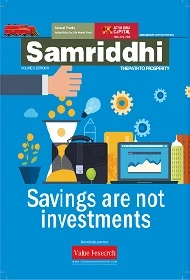
Samriddhi Volume 06 Edition 09 by ABSLMF
In today’s evolving financial landscape, understanding Saving vs Investment is essential. Many people ask, “Are savings an investment?” or seek the difference between savings and investment explained simply. While both play important roles, they serve different purposes. Saving protects money for emergencies and short-term needs, while investment helps grow wealth and beat inflation over time.
Using familiar options like Public Provident Fund (PPF), Equity Linked Savings Scheme (ELSS), debt funds, and balanced hybrid funds, the Saving vs Investment guide explains how to build a strong financial foundation. With better financial literacy, goal-based planning, and disciplined investing, you can aim for a secure future.
Key Insights:
• Savings ≠ Investments: Savings keep money safe but may lose value due to inflation.
• Hierarchy of financial needs: Start with an emergency fund, add term insurance, then begin investing.
• Match time horizon and risk appetite: Use debt funds for short-term goals and ELSS or equity mutual funds for potential long-term growth.
• Keep a balanced approach: A mix of equity and fixed-income funds can reduce risk.
• Use a Systematic Investment Plan (SIP) to invest regularly and avoid market timing.
Takeaways:
• Relying only on savings won’t help you build wealth - you need to invest to stay ahead of inflation.
• Always build your emergency fund and buy term insurance before looking for high returns.
• Pick the right fund based on your goals and how much risk you’re comfortable with.
• Avoid overcomplicating: A few well-chosen funds like balanced, multi-cap funds, and debt funds can be enough.
• Stay disciplined and keep investing until you reach your goals or need to review performance.
Why Download This Edition eBook?
• Get a clear understanding of Saving vs Investment and why savings are not investments.
• Follow a practical roadmap: emergency fund → term insurance → short-term investing → long-term investing.
• Learn how to use common investment tools like debt funds, ELSS, balanced funds, and multi-cap funds.
• Understand the importance of inflation, SIP, tax planning, and portfolio diversification.
• Created specifically for Indian investors - includes insights on PPF, ELSS, Senior Citizens Savings Scheme (SCSS), and Section 80C benefits (Income Tax Act, 1961).
To Know More, Download Saving vs Investment | Difference Between Savings and Investment | Samriddhi Volume 06 Edition 09 and take charge of your financial future!
Frequently Asked Questions on Saving vs Investment
When should I choose Saving vs Investment?
Choose Saving vs Investment based on your goals: save for emergencies and short-term needs and invest for long-term growth and inflation-beating returns.
A simple rule is saved first → insure → then invest.
Is it better to save or invest?
Saving is better for safety and liquidity, while investment is better for wealth creation.
Ideally, use both, save 3-6 months of expenses, then invest regularly through SIPs or long-term funds.
What is the 70-30 rule in Saving vs Investment?
The 70-30 rule suggests allocating 70% to equities for long-term growth and 30% to fixed income for stability.
This simple approach makes Saving vs Investment decisions easier for beginners and reduces risk through diversification.
What is the difference between Saving vs Investment?
The key difference between savings and investment is purpose: savings protect your money, while investments can help it grow.
Savings keep cash accessible, but investments like investments like ELSS multi-cap or debt funds help you beat inflation.
What are the disadvantages of relying only on savings?
Relying only on savings exposes you to inflation risk and limits long-term wealth creation. Without investment, your purchasing power declines over time.
Learn how to shift from only saving to a balanced saving-and-investing strategy strengthens your financial future.
Click Here to Visit Different Editions of Volume 06:
Saving vs Investment |
Savings Are Not Investments |
Financial Tips for Vacation |
Budget Travel Tips |
Investing for Life Goals |
Crash-Proof Investing.
Disclaimer:
SIP does not assure a profit or guarantee protection against loss in a declining market.
Investors are advised to consult their tax consultant or financial advisor to determine tax benefits applicable to them.
An Investor Education and Awareness Initiative of Aditya Birla Sun Life Mutual Fund.
All investors have to go through a one-time KYC (Know Your Customer) process. Investors to invest only with SEBI registered Mutual Funds. For further information on KYC, list of SEBI registered Mutual Funds and redressal of complaints including details about SEBI SCORES portal, visit link: https://mutualfund.adityabirlacapital.com/Investor-Education/education/kyc-and-redressal for further details.
Mutual Fund investments are subject to market risks, read all scheme related documents carefully.
म्यूचुअल फंड निवेश बाज़ार जोखिम के अधीन हैं, योजना संबंधी सभी दस्तावेज़ों को सावधानी से पढ़ें।

 Home Loans
 Personal Loans
 SME Loans
 Business Loans - Udyog Plus
  Loan Against Securites
 Loan Against Property
 Mutual Fund
 Stock and Securities
 Wealth
 Portfolio Management Services
 Pension Funds
 Life Insurance
 Health Insurance
 Wellness Solutions
 Pay Bills
 Pay for anything
 Pay Anyone
 Pay on Call
 Credit Cards
 Prepaid Gift Card



 1800-270-7000