Home Loans
 Personal Loans
 SME Loans
 Business Loans - Udyog Plus
  Loan Against Securites
 Loan Against Property
 Mutual Fund
 Stock and Securities
 Wealth
 Portfolio Management Services
 Pension Funds
 Life Insurance
 Health Insurance
 Wellness Solutions
 Pay Bills
 Pay for anything
 Pay Anyone
 Pay on Call
 Credit Cards
 Prepaid Gift Card



 1800-270-7000





Basics of Derivatives
Basics of Derivatives
A derivative is a contract or a product whose value is derived from the value of some other asset known as the underlying. Derivatives are based on a wide range of underlying assets.
- Petrol
- Diesel
- Kerosene
- Curd
- Paneer
- Buttermilk
In both examples, the value of the derivative product is linked to the value of the underlying asset. Changes in the underlying asset directly influence the derivative.
Forward Contract
Forward Contract
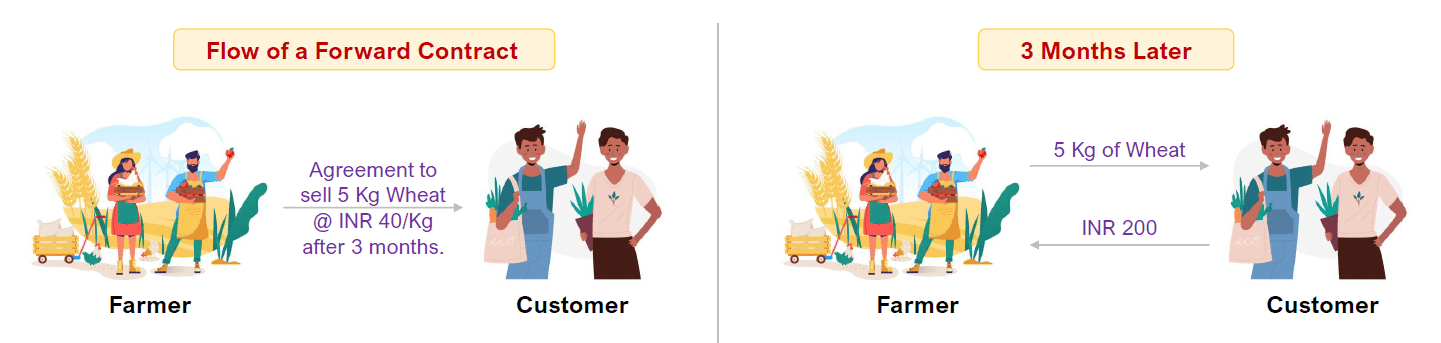
Essential features of a forward contract are:
- It is a contract between two parties (Bilateral contract).
- All terms of the contract like price, quantity and quality of underlying, delivery terms like place, settlement procedure etc. are fixed on the day of entering into the contract.
Major Limitation of Forward Contracts
Liquidity Risk
Liquidity refers to the ability of the market participants to buy or sell the desired quantity of an underlying asset. As forwards are tailor-made contracts i.e. the terms of the contract are according to the specific requirements of the parties, other market participants may not be interested in these contracts.
Counterparty Risk
Counterparty risk is the risk of economic loss arising from the failure of a counterparty.
Market Participants
Market Participants
1. Hedgers
Entrepreneurs, corporations, investing institutions and banks all use derivative products to hedge or reduce their exposures to market variables such as interest rates, share values, bond prices, currency exchange rates and commodity prices.
2. Traders/Speculators
Try to predict the future movements in prices of underlying assets and based on the view, take positions in derivative contracts. Derivatives are preferred over underlying asset for trading purpose, as they offer leverage, are less expensive (cost transaction is generally lower than that of the underlying) and are faster to execute in size (high volumes market).
3. Arbitrageurs
Originates when a trader purchases an asset cheaply in one location and simultaneously arranges to sell it at a higher price in another location. Such opportunities are unlikely to persist for very long, since arbitrageurs would rush into these transactions, thus closing the price gap at different locations.
Significance of Derivatives
Significance of Derivatives
It helps in improving price discovery based on actual valuations and expectations.
It enables the transfer of various risks from those who are exposed to risk but have a low risk appetite to participants with a high-risk appetite. For example, hedgers want to give away the risk whereas traders are willing to take risk.
It enables the shift of speculative trades from the unorganized market to the organized market. Risk management mechanism and surveillance of activities of various participants in the organized space provide stability to the financial system.
Practice Questions
Practice Questions
Question 1
___________________ wants to make money at all the time regardless of any fluctuations happening in the market.
- Straddle
- Hedger
- Speculator
- All of the above
Show Answer
Question 2
What does hedging do?
- It maximises business profits
- It minimises business losses
- It produces a clearer outcome
- Hedging can be used only in currency markets and not in equity markets
Show Answer
Hedging is a risk management strategy used by businesses or investors to reduce the potential adverse effects of price movements in financial markets.
Analogy: Amazon Shopping vs Stock Market
Analogy: Amazon Shopping vs Stock Market
| Amazon Shopping | Stock Market |
|---|---|
| Buyer: Click 'Buy' | Buyer places Buy order |
| Seller: Click 'Sell' (he has the product) | Seller places Sell order (he has the shares) |
| Order details sent to Amazon system | Trade details sent to Clearing Corporation |
| Amazon checks if seller has stock | Depositories confirm seller has shares to Clearing Corporation |
| Product moved to Amazon warehouse | Seller’s shares moved to a pool account (temporary holding) to be ready for delivery |
| Final stock balance check | Depository does a final check to avoid errors and confirms final balance |
| Amazon adjusts orders/returns (netting) | Clearing Corp nets out broker’s trades. Example: Buy 1,000 shares, Sell 600 shares = only 400 need to be settled |
| Buyer pays and gets delivery | Funds and shares exchanged (Pay-in/Pay-out). On settlement day (T+1 or T+2): Buyers’ brokers pay money; Sellers’ brokers deliver shares |
| Amazon: 'Order delivered successfully’ | Clearing & Settlement completed. Clearing Corporation ensures money goes to sellers and shares go to buyers |
| Amazon is middleman between buyer and seller | Clearing Corp acts as counterparty (Novation) |
| If seller fails, Amazon finds another seller/refunds | If seller defaults, Clearing Corp holds auction/compensates. If seller fails, Clearing Corporation buys shares from the market (auction) or compensates the buyer |
Legal and Regulatory Framework
Legal and Regulatory Framework
Securities Contracts (Regulation) Act, 1956 (SCRA)
Governs stock trading and aims to prevent market manipulation.
SEBI Act, 1992
Establishes the Securities and Exchange Board of India (SEBI) to regulate and protect investors.
Practice Questions
Practice Questions
Question 1
What does novation mean in the context of trade clearing?
- The clearing corporation becomes the legal counterparty to both sides of every trade.
- Modification of an order before it is executed on the exchange.
- Cancellation of unsettled trades at the end of the day.
- A penalty charged by the exchange for default.
View Answer
Question 2
What is multilateral netting as performed by the clearing corporation?
- Consolidating all trades of all clearing members to determine net delivery and payment obligations for each member, rather than settling trade-by-trade.
- Offsetting buy and sell orders before trade execution on the exchange.
- Pairing each buyer with a single specific seller for delivery (bilateral netting only).
- Netting off a broker’s losses in one security against profits in another security for margin benefit.
View Answer
Question 3
A Clearing Member has to deposit ______________ to clearing corporation which forms part of the security deposit.
- Rs. 50 Lakhs
- Rs. 100 Lakhs
- Rs. 150 Lakhs
- Rs. 20 Lakhs
View Answer
Clearing Member Eligibility Norms • Net-worth of at least Rs.300 lakhs. The Net-worth requirement for a Clearing Member who clears and settles only deals executed by him is Rs. 100 lakhs. • Deposit of Rs. 50 lakhs to clearing corporation which forms part of the security deposit of the Clearing Member. • Additional incremental deposits of Rs.10 lakhs to clearing corporation for each additional TM, in case the Clearing Member undertakes to clear and settle deals for other TMs.
Quick Comparison: Forwards vs Futures
Quick Comparison: Forwards vs Futures
| Feature | Forwards | Futures |
|---|---|---|
| Trading | Private (OTC) | Exchange Traded |
| Customization | Fully Customizable | Standardized |
| Counterparty Risk | High | Low (Clearing House) |
| Settlement | At Expiry | Daily Mark-to-Market |
| Liquidity | Low | High |
| Settlement | Delivery | Cash Settled |
| Underlying | Commodities, Oil, Agriculture, Currency | Equity Stocks, Equity Index, Currency, Interest Rates |
| Price Discovery | Less Transparent | Transparent via Exchange |
Future - Long and Short Pay-off in a nut-shell
Future - Long and Short Pay-off in a nut-shell
| Strategy | Right/Obligation | Market View (Expectation) | Profit Potential | Loss Potential | Premium Involved | Margin Required |
|---|---|---|---|---|---|---|
| Futures Buy (Long) | Obligation to buy at agreed price | Bullish (Expect ↑) | Unlimited | Unlimited | No | Yes |
| Futures Sell (Short) | Obligation to sell at agreed price | Bearish (Expect ↓) | Unlimited | Unlimited | No | Yes |
Meaning of Margin
Meaning of Margin
Margin is the sum that is blocked from our account when we open a derivatives position. Formula
Components of Initial Margin
SPAN Margin
SPAN (Standard Portfolio Analysis of Risk) Think of it as a risk calculator used worldwide. It looks at your entire portfolio and figures out: “If the market moves badly tomorrow, how much can you lose?” Based on this, it decides how much margin (deposit) you must keep.
Exposure Margin
This adds an extra buffer-against sudden, wild swings. For stock futures and option selling, it’s approximately 3.5% of the contract value. For index derivatives, it's around 2-3%.
Example (Nifty Futures, Lot Size = 75)
Day 1: Entry
Buy Nifty futures at ₹17,800. Contract value = ₹17,800 × 75 = ₹13.35 lakh.
Margin blocked (say 12%) = ₹1.6 lakh.
Closing price = ₹18,000.
Gain = (18,000 – 17,800) × 75 = ₹15,000.
Profit added → Margin balance rises to ₹1.75 lakh.
Day 2
Reference = 18,000. Closing = ₹17,900.
Loss = (17,900 –18,000) ×75 = -₹7,500.
Loss deducted → Margin balance falls to ₹1.675 lakh.
Day 3
Reference = 17,900. Closing = ₹18,100.
Gain = (18,100 – 17,900) × 75 = ₹15,000.
Profit added → Margin balance becomes ₹1.825 lakh.
Futures Pricing
The Cash and Carry Model explains that the futures price equals the spot price plus the cost of carry minus any income from the asset (like dividends).
F = Futures Price
S = Spot Price
This is the basic version, used when costs/income are expressed in rupee terms or using simple interest.
Practice Questions
Practice Questions
Question 1
Which of the following statements best distinguishes a forward contract from a futures contract?
- Forwards are standardized contracts traded on exchanges, while futures are private agreements traded over-the-counter.
- Forwards settle gains/losses only at maturity, whereas futures are marked-to-market daily with margins.
- Forwards carry minimal credit risk due to clearinghouse guarantees, whereas futures have high counterparty default risk.
- Forwards require an initial margin deposit, while futures typically require no upfront payment.
View Answer
Question 2
Suppose the spot price of a stock index is ₹10,000. The risk-free interest rate is 6% per annum. Assume no dividends on the index and no other holding costs or benefits. What is the fair futures price for a contract expiring in 6 months (0.5 year), based on the cost-of-carry model? (Use simple interest for approximation.)
- ₹10,000
- ₹10,300
- ₹10,600
- ₹10,700
View Answer
Question 3
Mr. Sharma shorts 1 lot of XYZ futures at ₹200 per unit. Each lot represents 100 units. Later, he closes (squares off) his position at ₹180 per unit. What is Mr. Sharma’s profit or loss on this futures trade (ignoring transaction costs)?
- ₹2,000 profit
- ₹2,000 loss
- ₹20 profit
- ₹20 loss
View Answer
• A short futures position profits when prices fall.
• Mr. Sharma sold at ₹200 and bought back at ₹180, gaining ₹20 per unit. With a lot size of 100 units, his total profit = ₹20 × 100 = ₹2,000. This is a realized profit added to his account.
Question 4
If a trader’s futures position incurs losses such that the funds in the margin account fall below the required maintenance margin level, what typically happens?
- The trader will receive a margin call to deposit additional funds to restore the margin to the initial level.
- The position is automatically terminated by the exchange with no further action.
- The trader can continue to hold the position until expiry without adding funds.
- The losses are ignored as long as the trader has paid initial margin once.
View Answer
What are OPTIONS?
What are OPTIONS?
A Contract that:
- Gives the buyer the right, but not the obligation; To buy or sell a specified underlying asset; at a set price on or before a specified date
Types of OPTIONS Contract
| Buyer | Seller |
|---|---|
|
CALL Has the right to buy a stock at specified price |
CALL Has the obligation to sell a stock at a specified price |
|
PUT Has the right to sell a stock at specified price |
PUT Has the obligation to buy a stock at specified price |
Options Terminology
These options have a stock index as the underlying asset. For example, Options on Nifty, Sensex, etc.
These options have individual stocks as the underlying asset. For example, Option on ONGC, NTPC, etc.
The owner (buyer/holder) of an American Option can exercise his right at any time on or before the expiry date/day of the contract.
The owner (buyer/holder) of a European Option can exercise his right only on the expiry date/day of the contract. In India, all Index and Stock Options are European Style Options.
It is the price which the option buyer pays to the option seller.
It is the price at which the underlying asset is trading in the spot market. In our examples, it is the value of underlying index (Nifty 50) which was 18315.10 at that point of time.
Strike price is the price per share for which the underlying security may be purchased by the call option holder (or sold by the put option holder). In our examples, strike price for both call and put options is 18400.
Moneyness of an Option
In-the-money (ITM) Option
This option would give the option holder a positive cash flow, if it were exercised immediately. A call option is said to be ITM, when spot price is higher than strike price. A put option is said to be ITM when spot price is lower than strike price. In our examples, the put option is in-the-money.
At-the-money (ATM) Option
At-the-money option would lead to zero cash flow if it were exercised immediately. Therefore, for both call and put ATM options, strike price is equal to spot price. In reality, because the strike prices are at fixed intervals of say, Rs.5, Rs.10 or Rs.50, while the spot price moves in much smaller increments, the two prices may rarely be equal. Hence an ATM option can be defined as an option with a strike price which is closest to the spot price.
For example, if the index is at 18415 and three options on the index with strike prices of 18350, 18400 and 18450 are available for trading, the option with the strike price of 18400 is an ATM option.
Out-of-the-money (OTM) Option
An out-of-the-money option is one with a strike price worse than the spot price for the holder of option. In other words, this option would give the holder a negative cash flow if it were exercised immediately.
An out-of-the-money option is one with a strike price worse than the spot price for the holder of option. In other words, this option would give the holder a negative cash flow if it were exercised immediately. A call option is said to be OTM, when spot price is lower than strike price. A put option is said to be OTM when spot price is higher than strike price. In our examples, the call option is out-of-the-money.
Call Option – Right to Buy & Put Option – Right to Sell
Call Option – Right to Buy & Put Option – Right to Sell
Call Option – Right to Buy
A Call option gives the buyer the right (not obligation) to buy an asset at a fixed price (called Strike Price) before/at expiry.
The seller (writer) of the call is obligated to sell if the buyer chooses to exercise.
The buyer pays a Premium to the seller.
Premium is like a booking fee.
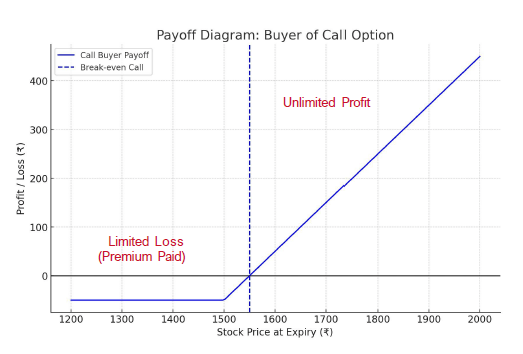
Call Buyer (Right to Buy at ₹1,500. Premium ₹50)
- Loss is limited to premium (₹50) → flat line below zero.
- Profit starts after ₹1,550 (Strike + Premium = Breakeven Price) and grows unlimited as stock price rises.
Put Option – Right to Sell
A Put Option gives the buyer the right (not obligation) to sell an asset at strike price before/at expiry.
The seller (writer) of the put must buy if the buyer exercises.
Buyer pays premium, risk is limited, and the seller receives the premium.
Buying a Put Option Profitability depends on the Concept of Selling High at price and Buying at a Low price.
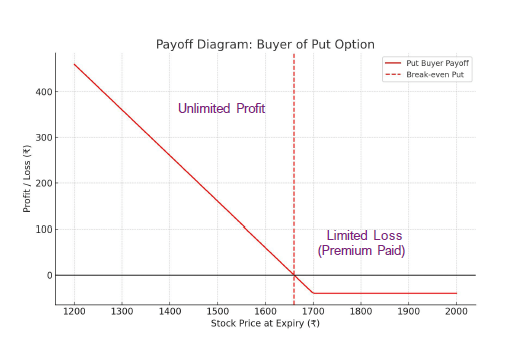
Put Buyer (Right to Sell at ₹1,700, Premium ₹40)
- Loss is limited to premium (₹40) → flat line below zero.
- Profit starts after ₹1,660 (Strike Premium = Break even) and increases as stock price falls.
In Short
| Call Option | Put Option |
|---|---|
| Call Buyer = Spot Price > Strike Price = Intrinsic Value | Put Buyer = Spot Price < Strike Price = Intrinsic Value |
| Intrinsic Value = Spot Price – Strike Price | Intrinsic Value = Strike Price – Spot Price |
| Example: Strike Price is Rs. 100; Spot Price is Rs. 200 | Example: Strike Price is Rs. 100; Spot Price is Rs. 50 |
| Intrinsic Value = 200 - 100 = Rs. 100 | Intrinsic Value = 100 - 50 = Rs. 50 |
| Assume Premium Paid by the Call Buyer is Rs. 20 | Assume Premium Paid by the Put Buyer is Rs. 20 |
| Profit =Rs. 100 –Rs. 20 = Rs. 80 | Profit =Rs. 50 –Rs. 20 =Rs. 30 |
| Break-even Price = Rs. 100 + Rs. 20 = Rs. 120 (Strike Price + Premium) | Break-even Price = Rs. 100 - Rs. 20 = Rs. 80 (Strike Price – Premium) |
| For a Call Seller, the maximum gain is the premium received, but loss is unlimited. | For a Put Seller, the maximum gain is the premium received (Rs. 20), but loss is unlimited. |
Quick Recap – Call and Put Option
Quick Recap – Call and Put Option
| Strategy | Right / Obligation | Market View (Expectation) | Profit Potential | Loss Potential | Premium Involved | Margin Required |
|---|---|---|---|---|---|---|
| Call Buy | Right to buy at strike price | Bullish (Expect ↑) | Unlimited | Limited (to premium paid) | Pay | No |
| Call Sell | Obligation to sell if buyer exercises | Bearish / Neutral | Limited (Premium received) | Unlimited | Receive | Yes |
| Put Buy | Right to sell at strike price | Bearish (Expect ↓) | Unlimited (if price ↓ significantly) | Limited (to premium paid) | Pay | No |
| Put Sell | Obligation to buy if buyer exercises | Bullish / Neutral | Limited (Premium received) | Unlimited | Receive | Yes |
Practice Questions
Practice Questions
Question 1
If you sell a put option with strike of Rs. 245 at a premium of Rs.40, how much is the maximum gain that you may have on expiry of this position?
- 285
- 40
- 0
- 205
View Answer
For a Put Seller, Gain is limited to premium received but the loss is unlimited.
Question 2
Spot Price = Rs. 100. Call Option Strike Price = Rs. 98. Premium = Rs. 4. An investor buys the Option contract. On Expiry of the Option the Spot price is Rs. 108. Net profit for the Buyer of the Option is _____________.
- Rs. 6
- Rs. 5
- Rs. 2
- Rs. 4
View Answer
As Spot Price > Strike Price; It is a gain for the Call Option Buyer. Gain = (108-98) - 4 = 10 - 4 = 6
Quick Recap
Quick Recap
Moneyness – Depicts profitability of the Option Contract.
It is always from the perspective of a Call Buyer and Put Buyer.
| Option Type | In the Money (ITM) | At the Money (ATM) | Out of the Money (OTM) |
|---|---|---|---|
| Call Option (Right to Buy) | Spot Price > Strike Price | Spot Price ≈ Strike Price | Spot Price < Strike Price |
| Put Option (Right to Sell) | Spot Price < Strike Price | Spot Price ≈ Strike Price | Spot Price > Strike Price |
Practice Questions
Practice Questions
Question 1
If in case of Put Buy, Spot Price < Strike Price then it means a person is in __________ situation.
- At the money
- In the money
- Out the money
View Answer
Question 2
In-The-Money option is ____________.
- An option with a negative intrinsic value
- An option which cannot be profitably exercised by the holder immediately
- An option with a positive intrinsic value
- An option with zero-time value
View Answer
Option Premium
Option Premium
Practice Questions
Practice Question
Question
A stock option has an intrinsic value of ₹40 and a time value of ₹25. What is the total Option Premium?
- ₹ 15
- ₹ 25
- ₹ 40
- ₹ 65
View Answer
Time Value
Time Value
Time Value is the extra money you pay on top of the intrinsic value.
Why pay extra? Because there’s still hope (or chance) that the stock will move more in your favor before expiry.
The longer the time left to expiry → the more “hope” → higher time value.
Example
Infosys Spot Price = ₹1,600
Buy Call Option Strike Price = ₹1,500
Premium = ₹120
Intrinsic Value (IV) = 1,600 – 1,500 = ₹100
Option Premium = Intrinsic Value + Time Value
₹120 = ₹100 + Time Value
Time Value = 120 – 100 = ₹20
That ₹20 is the “extra hope” that Infosys may rise to ₹1700 or more before expiry.
Near expiry, Premium ≈ IV (since Time Value → 0). Time Value is always positive before expiry.
The content provided is for illustrative and educational purposes and should not be construed as investment advice. Please consult a qualified financial advisor for guidance tailored to your specific needs and situation.
Practice Questions
Practice Questions
Question 1
When there is an increase in time expiration, the premium of Call Option?
- Remains constant
- Increases
- Decreases
View Answer
Question 2
Premium of call option declines if Spot price _________________ .
- Increases
- Decreases
- Data is in sufficient
View Answer
If Spot Price < Strike Price for a Call option, it is a loss. So, the Intrinsic Value (IV) becomes less. As Option Premium = IV + TV; due to lower IV, Option Premium decreases.
Question 3
The increased Volatility of a spot price leads to ________________________________ .
- Increase in Call Premium.
- Increase in Put Premiums.
- Increases in both Call and Put Premium.
- Decrease in both call and Put premium.
View Answer
More volatility of a stock means more uncertainty, hence higher premium.
Intrinsic Value and Time Value of an Option, and Payoff Charts for Options
Intrinsic Value and Time Value of an Option
The option premium, defined above, consists of two components - intrinsic value and time value.
The intrinsic value of an option refers to the amount by which the option is in-the-money i.e., the amount an option buyer will realize, before adjusting for premium paid, if he exercises the option instantly.
Therefore, only in-the-money options have intrinsic value whereas at-the-money and out-of-the-money options have zero intrinsic value.
The intrinsic value of an option can never be negative because an option holder is not bound to exercise an option if such exercise will result in a loss to him.
Payoff Charts for Options
Long option
Long option Buyer of an option is said to be “long the option”. As described above, he/she would have a right and no obligation with regard to buying/ selling the underlying asset in the contract. When you are long an equity option contract:
- You have the right to exercise that option.
- Your potential loss is limited to the premium amount you paid for buying the option.
- Profit would depend on the level of underlying asset price at the time of exercise/expiry of the contract.
Short option
Short option Seller of an option is said to be “short the option”. As described above, he/she would have an obligation but no right with regard to selling/buying the underlying asset in the contract. When you are short (i.e., the writer of) an equity option contract:
- Your maximum profit is the premium received.
- You can be assigned an exercised option any time during the life of option contract (in case of American options). All option writers should be aware that assignment is a distinct possibility.
- Your potential loss is theoretically unlimited as defined below.
Different Option Strategies
Different Option Strategies
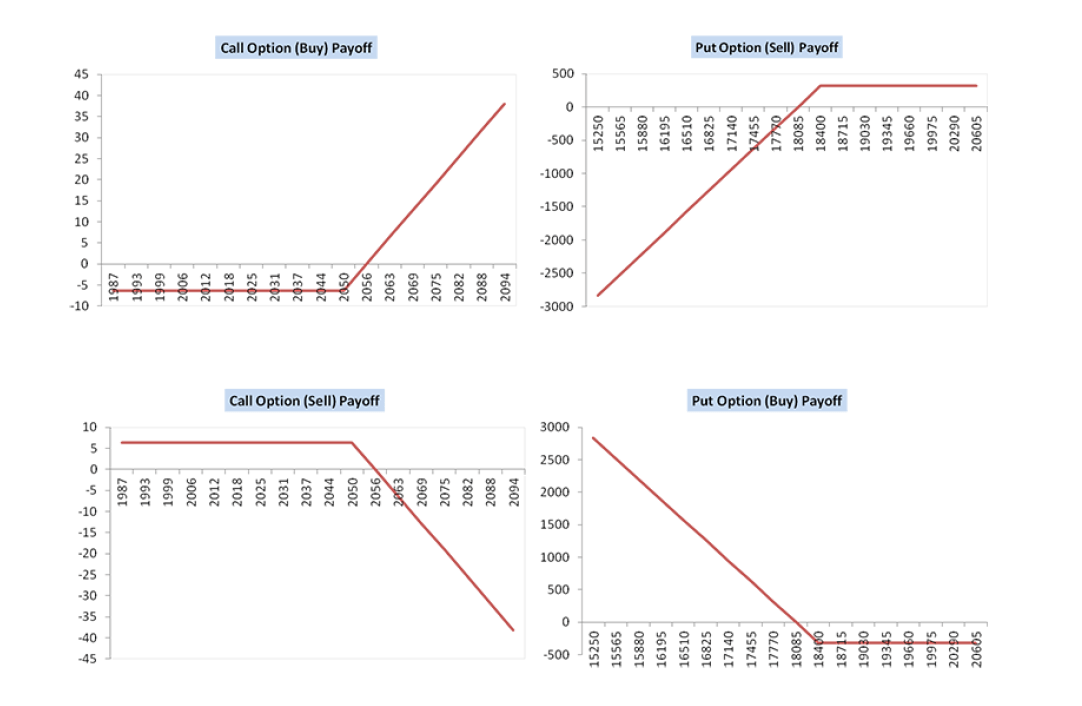
| Your Market View | Option Type | Position also Called | Other Alternatives | Premium |
|---|---|---|---|---|
| Bullish | Call Option (Buy) | Long Call | Buy Futures or Buy Spot | Pay |
| Flat or Bullish | Put Option (Sell) | Short Put | Buy Futures or Buy Spot | Receive |
| Flat or Bearish | Call Option (Sell) | Short Call | Sell Futures | Receive |
| Bearish | Put Option (Buy) | Long Put | Sell Futures | Pay |
Remember these Graphs
8 Option Trading Strategies
8 Option Trading Strategies
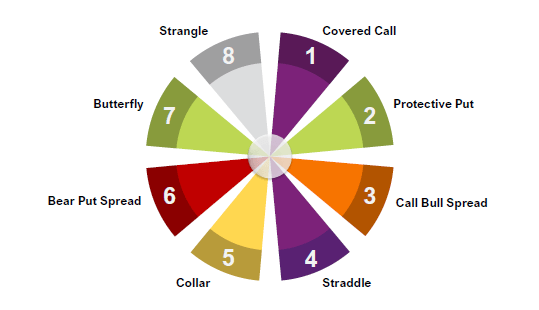
Option Trading Strategies
| Strategy | Market View | Basic Idea |
|---|---|---|
| Long Call | Bullish | Buy a call option expecting the price of the stock to rise. Profit if price increases. |
| Long Put | Bearish | Buy a put option expecting the price of the stock to fall. Profit if price declines. |
| Covered Call | Slightly Bullish / Neutral | Hold the stock and sell a call option to earn premium income. |
| Protective Put | Bullish with Protection | Buy stock and buy a put option to protect against possible downside. |
| Bull Call Spread | Moderately Bullish | Buy a call at lower strike and sell another call at higher strike to reduce cost. |
| Bear Put Spread | Moderately Bearish | Buy a put at higher strike and sell another put at lower strike. |
| Straddle | High Volatility | Buy call + put at same strike expecting big movement in either direction. |
| Strangle | High Volatility | Buy call + put at different strikes expecting large price movement. |
Practice Questions
Practice Questions
Question 1
You buy a stock at ₹500 and sell a Call Option (₹520 strike) for ₹15. If the stock rises to ₹550, what is your total profit?
- ₹ 15
- ₹ 20
- ₹ 35
- ₹ 50
View Answer
Selling a Call Option at a strike price of Rs. 520 means if the stock goes to ₹550, the Call Option will get exercised at ₹520. Profit Range is between ₹520 and ₹500.
Your profit is ₹520 – ₹500 + 15 premium (which is like your rental income) = ₹20 + ₹15 = ₹35
Question 2
You own a stock at ₹600 and buy a Put Option (₹580 strike, ₹12 premium). If the stock crashes to ₹550, what is your put option gain?
- ₹ 12
- ₹ 18
- ₹ 32
- ₹ 50
View Answer
First Identify the Strategy Owning a Stock + Buying a Put Option = Protective Put
Put Option = 580 – 550 = Rs. 30.
Net Gain = Rs. 30 – Rs. 12 = Rs. 18
Collar - Example
Collar - Example
Step 1: Situation
You own Infosys at Spot Price of ₹1,600.
You buy a Put Strike 1,550, Premium paid is ₹30 (protection). (OTM)
You sell a Call Strike 1,700, Premium received is ₹30 (income).
Net Premium Cost = + ₹30 - ₹30 = ₹0
Call Bull Spread
Assume NIFTY is at 22,000
Buy 22,000 Call at ₹200 premium
Sell 22,300 Call at ₹80 premium
Net cost (premium paid)
– ₹200 + ₹80 = – ₹120
Outcomes
Maximum Loss = ₹120 (if NIFTY stays below 22,000)
NIFTY at 23,000; Buy Call Profit is 23,000 – 22,000 = 1,000; Sell Call Loss: – 22,300 – 23,000 = – 700 loss.
Net Gain = 1000 – 700 – 120 = 300 – 120 = 180
Bear Put Spread
Buy a Put Option (higher strike)
Sell a Put Option (lower strike)
Assume NIFTY is at 22,000
Buy 22,000 Put at ₹210 premium
Sell 21,700 Put at ₹90 premium
Net Cost
- ₹210 + ₹90 = - ₹120
Straddle is the strategy used in Volatile Markets
Straddle is the strategy used in Volatile Markets
Buying a Call Option by paying premium of Rs. 10 and Buying a Put Option by paying a premium of Rs. 8 at a strike price of Rs. 400.
Total Option Premium Payout is Rs. 10 + Rs. 8 = Rs. 18
Profit for a Call Option buyer > Rs. 418
If the latest Spot Price is 450.
Then the overall Gain is 450 - 418 = Rs. 32
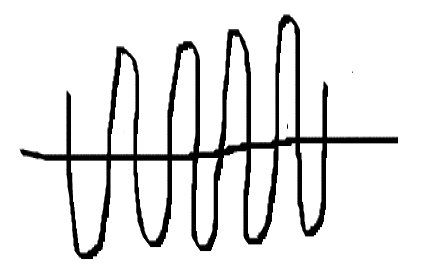
Profit for a Put Option buyer < Rs. 382
If the latest Spot Price is 350.
Then the overall Gain is 382 - 350 = Rs. 32
When Strike Price = Spot price
The contract is At the Money (ATM)
The content provided is for illustrative and educational purposes and should not be construed as investment advice. Please consult a qualified financial advisor for guidance tailored to your specific needs and situation.
Strangle
Strangle
Buy Call OTM (higher strike) + Put OTM (lower strike). 2 Leg
Cheaper than Straddle, as the contracts are OTM but stock needs larger move to profit
Example (TCS Spot Price is at ₹400)
Buy Call with a Strike price of ₹405 @ ₹3 premium.
Buy Put with a Strike price of ₹395 @ ₹2 premium.
Total Premium Cost = ₹5
₹405 + ₹5 = ₹410
₹395 - ₹5 = ₹390
- Strike Price for the Call and Put Option Buyer is different that the Spot Price; How-ever they are equi-distant from the Spot price.
- They are OTM contracts.
- For Call: Spot Price should be higher than Strike Price; For Put: Spot Price should be lower than Strike Price. As these conditions are not met. Strangles are OTM contracts.
Option Greeks
Delta
The most important of the ‘Greeks’ is the option’s “Delta”. This measures the sensitivity of the option value to a given small change in the price of the underlying asset.
Delta = Change in option premium / Unit change in price of the underlying asset.
Gamma (γ)
Gamma measures change in delta with respect to change in price of the underlying asset.
Gamma = Change in an option delta / Unit change in price of underlying asset.
Theta (θ)
Theta is the measure of an option’s sensitivity to time decay.
Theta = Change in an option premium / Change in time to expiry.
Vega (ν)
Vega is the measure of the sensitivity of an option price to changes in market volatility.
Vega = Change in an option premium / Change in volatility.
Rho
Rho is the change in option price given a one percentage point change in the risk-free interest rate.
Rho = Change in an option premium / Change in cost of funding the underlying.
Practice Questions
Question
A trader buys a Straddle (₹300 strike) with a Call at ₹20 and a Put at ₹18. What is the lower breakeven price?
- ₹ 260
- ₹ 262
- ₹ 265
- ₹ 268
View Answer
Total Premium Paid = ₹20 + ₹18 = ₹38
Straddle always happens at Strike Price = ₹300; Which means Buying a Put Option and Call Option at ₹300.
Lower Break-even price means Buying a Put option = ₹300 - ₹38 = ₹262.
Butterfly Option Strategy
Butterfly Option Strategy
Strike price (OTM)
Strike price = Spot price
Strike price (ITM)
Key Features
Key Features
You expect low volatility (stock won’t move much away from spot).
Your maximum loss = the net premium you pay.
Your maximum gain = when the stock closes exactly at the middle strike price.
Call Sell positions will hedge it.
Key Currency Terms
Key Currency Terms
1. Base Currency
The first currency in any currency pair.
It is the currency whose value you want to measure.
In USD / INR, the base currency is USD.
Example
→ 1 USD (base) is worth ₹84.
2. Quote Currency
The second currency in the pair.
It tells you how much of this currency is needed to buy 1 unit of the base currency.
In USD / INR, the quote currency is INR.
Example
→ You must pay ₹84 for 1 USD.
3. Direct Quote
A quote where the foreign currency is the base (numerator) and the home currency is the quote (denominator).
For an Indian resident, USD / INR, EUR / INR, GBP / INR are all direct quotes.
It tells you: “How many rupees for 1 unit of foreign currency?”
Example
→ You must pay ₹84 for 1 USD. (Direct Quote in India)
Analogy:
Just like seeing product prices in rupees in an Indian store.
4. Inverse Quote
A quote where the home currency becomes the base currency.
It tells you: “How many units of foreign currency equal 1 rupee?”
For India: INR / USD, INR / GBP, INR / EUR.
Example
→ INR / USD = 1/84 = 0.0119 USD per ₹1
Analogy:
It is like asking, “How much foreign currency will I receive for ₹1?”
5. Cross Currency
Example
USD / INR and GBP / INR
Assume in India = 0.75 (Manufactured Rate)
Assume in London = 0.80
Practice Questions
Practice Questions
Question 1
A person sells GBP / INR and buys EUR / INR for an equivalent amount. What view is he expressing?
- INR Appreciation against EUR
- EUR Appreciation against GBP
- EUR Depreciation against GBP
- INR Depreciation against GBP
View Answer
Question 2
Mr. Mohit buys 36 lots of USD/INR 1-month future when the price was 45.50/45.65 and squares off 20 lots when the price was 46.30/46.50. How much profit / loss has he made on the squared-off position?
- Loss of 11,500
- Profit of 12,300
- Profit of 13,000
- Profit of 11,750
View Answer
Profit per USD = 46.30 − 45.65 = 0.65; Profit = 20 lots × 1000 × 0.65 = ₹13,000
Interest Rate Derivative
Interest Rate Derivative
Interest Rate Derivative is a financial contract whose value depends on interest rates.
It is mainly used to manage or hedge the risk of changing interest rates.
In simple terms:
- It is an agreement between two parties based on future interest rate movements.
- Companies, banks, and investors use it to protect themselves from rising or falling interest rates.
- The value of the contract changes when interest rates change.
- No physical asset is usually exchanged - only cash difference is settled.
- Common types include Interest Rate Swaps, Futures, Options, and Forward Rate Agreements.
- For example, a company taking a loan may use it to lock a fixed interest rate if rates might rise.
- Banks also use it to manage their lending and borrowing risks.
- Investors may use it for hedging or speculation on rate movements.
- These instruments are widely used in bond and money markets.
Price Risk (Interest Rate Risk) and Reinvestment Risk
|
Price Risk
(Interest Rate Risk) |
Reinvestment Risk
|
|
|
If Interest Rate goes up ►
|
⬆ | ⬇ |
|
If Interest Rate goes down ►
|
⬇ | ⬆ |
Different Types of Yield Curve
Different Types of Yield Curve
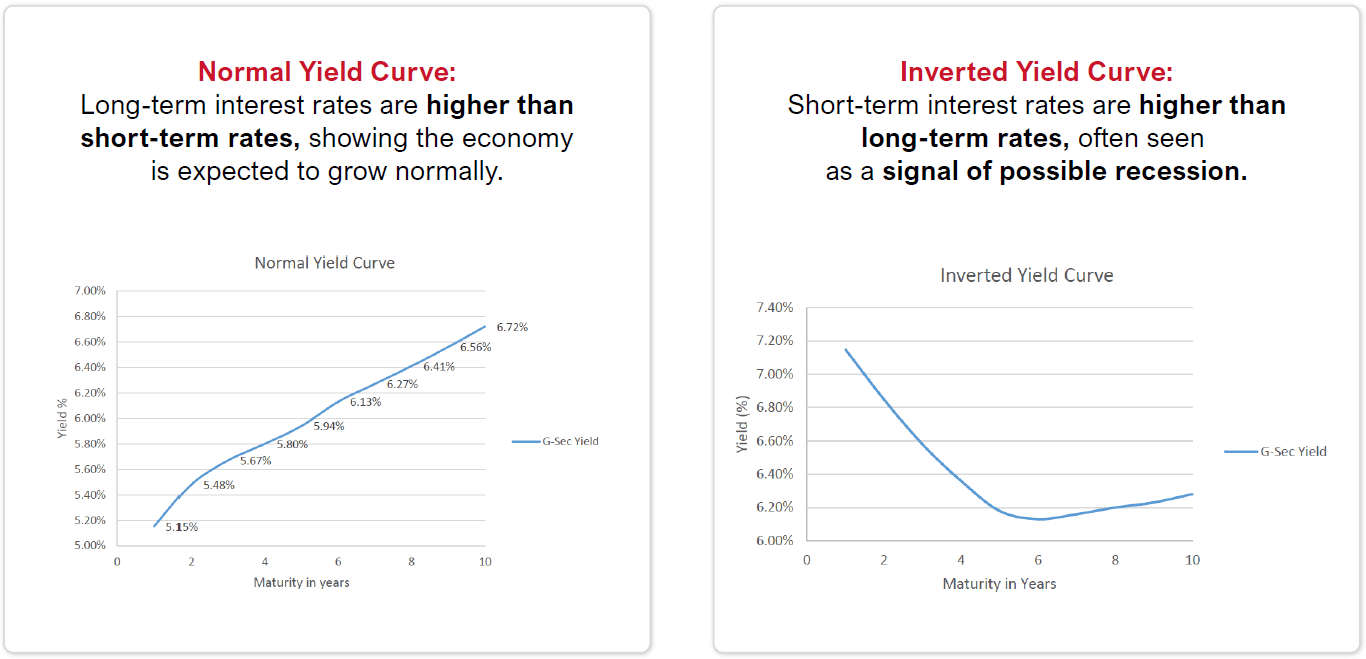
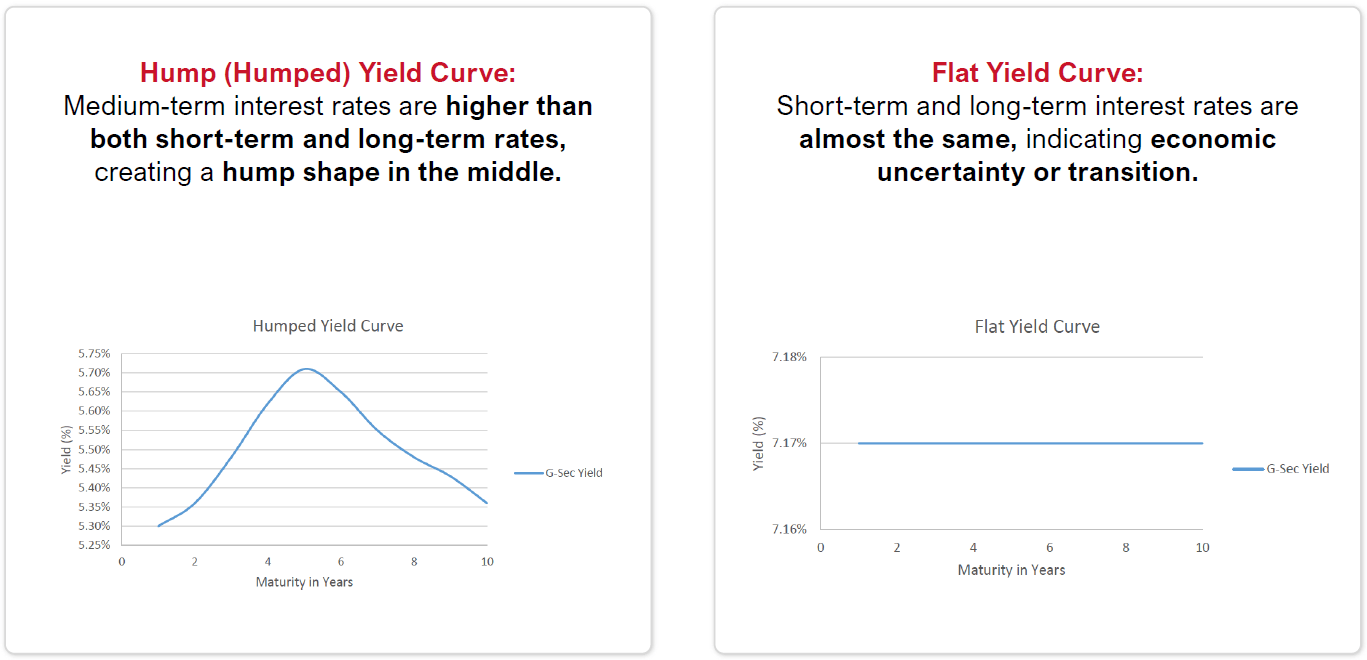
Term Structure of Rates: Shifts
Term Structure of Rates: Shifts
Steepening
Difference between LR and SR rises or widens. The curve shifts in anti-clockwise direction.
Flattening
Difference between LR and SR falls or narrows. The curve shifts in clockwise direction.
Parallel
All rates move in the same direction by same extent.
Steepening and flattening can occur in three ways: both rates move in opposite direction; both rates move in the same direction (either both rise or both fall) but by different extent; and one rate remains constant and the other changes (either rise or fall).
The first is called "twist" and the last two are called "convexity change".
| Before | After | Shift | ||||||||
|---|---|---|---|---|---|---|---|---|---|---|
| SR | LR | Spread | Shape | SR | LR | Spread | Shape | |||
| 7.00% | 8.00% | +1.00% | Normal | 6.90% | 8.10% | +1.20% | Normal | Steepening – twist | ||
| 7.00% | 8.00% | +1.00% | Normal | 7.10% | 8.20% | +1.10% | Normal | Steepening – Convex change | ||
| 7.00% | 8.00% | +1.00% | Normal | 6.80% | 7.90% | +1.10% | Normal | Steepening – Convex change | ||
| 7.00% | 8.00% | +1.00% | Normal | 6.90% | 8.00% | +1.10% | Normal | Steepening – Convex change | ||
| 7.00% | 8.00% | +1.00% | Normal | 7.00% | 8.10% | +1.10% | Normal | Steepening – Convex change | ||
| 7.00% | 8.00% | +1.00% | Normal | 7.10% | 8.10% | +1.00% | Normal | Parallel | ||
| 7.00% | 8.00% | +1.00% | Normal | 6.90% | 7.90% | +1.00% | Normal | Parallel | ||
| 7.00% | 8.00% | +1.00% | Normal | 7.10% | 7.90% | +0.80% | Normal | Steepening – twist | ||
| 7.00% | 8.00% | +1.00% | Normal | 7.20% | 8.10% | +0.90% | Normal | Steepening – Convex change | ||
| 7.00% | 8.00% | +1.00% | Normal | 6.90% | 7.80% | +0.90% | Normal | Steepening – Convex change | ||
| 7.00% | 8.00% | +1.00% | Normal | 7.10% | 8.00% | +0.90% | Normal | Steepening – Convex change | ||
| 7.00% | 8.00% | +1.00% | Normal | 7.00% | 7.90% | +0.90% | Normal | Steepening – Convex change | ||
| 8.00% | 8.00% | 0 | Flat | 8.10% | 8.10% | 0 | Flat | Parallel | ||
| 8.00% | 8.00% | 0 | Flat | 7.90% | 7.90% | 0 | Flat | Parallel | ||
| 8.00% | 8.00% | 0 | Flat | 8.00% | 8.10% | +0.10% | Normal | Steepening – Convex change | ||
| 8.00% | 8.00% | 0 | Flat | 8.10% | 8.20% | +0.10% | Normal | Steepening – Convex change | ||
| 8.00% | 8.00% | 0 | Flat | 7.90% | 8.10% | +0.20% | Normal | Steepening – twist | ||
Practice Questions
Practice Questions
Question
Credit spread is the price of ____________________ .
- Credit risk
- Reinvestment risk
- Price risk
- All of the above
View Answer
Question
If the long-term rate is 10% and short-term rate is 8%, the shape of term structure of rates is __________________.
- Normal / Positive
- Inverted / Negative
- Flat
- Humped
View Answer
Question
The concept of "accrued interest" applies to which of the following?
- Zero coupon bond
- Coupon bond
- Both (a) and (b)
- None of the above
View Answer
Question
If the coupon of the bond increases, its Modified Duration will _______________. (Other things remaining constant).
- Increase
- Decrease
- May increase or decrease
- Remain constant
View Answer
Question
If you expect the interest rate will go up in future, today you should _____________.
- Sell GOI Bond futures
- Buy GOI bond futures
- Buy underlying bond
- None of the above
View Answer
Different Types of Orders
Different Types of Orders
Limit Order
Buy or sell a share only at a specific price or better set by the investor.
IOC (Immediate or Cancel)
Order must be executed immediately (fully or partly); the remaining unexecuted portion is cancelled.
GTD (Good Till Date)
Order remains active until the specified date unless it is executed earlier.
Market Order
Buy or sell a share immediately at the current market price.
Stop-Loss Order
An order placed to limit losses by selling or buying when a trigger price is reached.
Practice Questions
Practice Questions
Question
A client can place order in exchange traded interest rate derivatives through _______.
- Phone
- Internet
- Direct Market Access
- All of the above
View Answer
Question
A Buy or a Sell order(s) which is/are lying unmatched in the order book are known as ________________.
- Active Orders
- Passive Orders
- Best Orders
- None of the above
View Answer
Question
A ___________ order is classified as price related condition.
- Market
- Day
- IOC
- None of the above
View Answer
Question
Due to denial of matched orders by client/s, which type of risk arises?
- Operational
- Market
- Regulatory
- None of the above
View Answer
Question
If the base rate of Overnight MIBOR futures is 5, then its operating range will be ________________.
- 5.05 & 4.95
- 5.10 & 4.90
- 5.25 & 4.75
- 5.50 & 4.50
View Answer
This is for NISM certified distributors only
This is for NISM certified distributors only
While reasonable efforts have been made to ensure the accuracy and reliability of the information presented in this document, Aditya Birla Sunlife Asset Management Company Limited does not guarantee its completeness or precision. Aditya Birla Sunlife Asset Management Company Limited, along with its subsidiaries, associates, partners, employees, and any connected persons, shall not be held responsible for any loss or damage arising from inadvertent errors in the information provided, or from any views and opinions expressed within this presentation.
Past performance is not indicative of future performance, and no express or implied representations or warranties are made regarding future outcomes. Information, opinions, and estimates contained herein reflect the judgment as of the original publication date and are subject to change without prior notice.
This presentation is not intended for distribution to, or use by, any individual or entity that is a citizen or resident of any jurisdiction where such distribution, publication, availability, or use would be in violation of local laws or regulations or would subject Aditya Birla Sunlife Asset Management Company Limited and its affiliates to any registration or licensing requirements within such jurisdictions.
The product described herein may not be eligible for sale in all jurisdictions or to certain categories of investors. It is the responsibility of persons in possession of this document to be aware of and adhere to such restrictions.
Before making any investment decisions, readers are advised to seek independent professional advice and verify the contents of this presentation to arrive at an informed decision.
The above questions are for illustrative purposes only and are intended solely for educational purposes.
Click Here to Visit Derivatives Questions and Answers: Equity Derivative FAQs | Interest Rate Derivative FAQs.