 Home Loans
 Personal Loans
 SME Loans
 Business Loans - Udyog Plus
  Loan Against Securites
 Loan Against Property
 Mutual Fund
 Stock and Securities
 Wealth
 Portfolio Management Services
 Pension Funds
 Life Insurance
 Health Insurance
 Wellness Solutions
 Pay Bills
 Pay for anything
 Pay Anyone
 Pay on Call
 Credit Cards
 Prepaid Gift Card



 1800-270-7000
-
Our Products
-
Self Care
- Downloads
- Learnings
- About Us
-
More
-
Shareholders
-
Shareholders
-
-
SIP Calculators

-
Shareholders
 IMPORTANT ALERT ! Beware of Fake AMC App, Online Impersonation & Scam WhatsApp Groups.

ABC Solution 
Loans
Insurance



 AppStore
 Playstore
Aditya Birla Sun Life AMC Limited


Aditya Birla Sun Life AMC Limited

What Is Quick Ratio? Meaning, Formula & How to Calculate
Jan 21, 2026
5 min
0 Rating
Short-term liquidity stress has been a recurring theme in corporate financial analysis. According to the IBBI working paper analysis, over 1,450 listed non-financial companies found that liquidity-related indicators frequently served as early signs of financial vulnerability .
The same study observed that among companies undergoing insolvency resolution, around 74% exhibited financial stress signals, as measured by liquidity and solvency indicator s, before deeper distress became visible.
What Is the Quick Ratio?
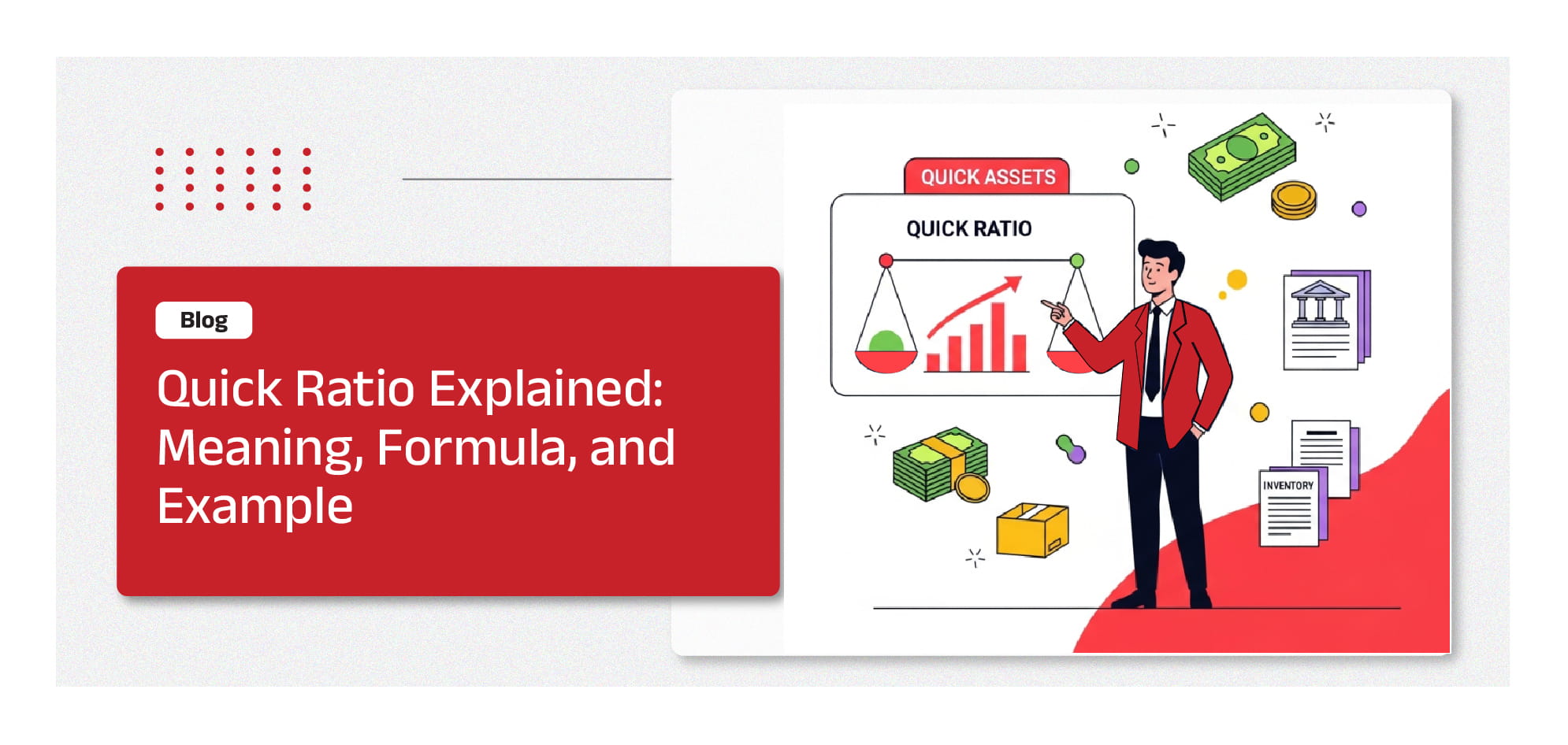
The quick ratio is a metric used to assess the ability of a company to meet short-term liabilities with assets that can be quickly converted into cash. These assets usually include cash, balances with customers, and short-term investments. Inventory is excluded because it may take time to sell and its value may vary depending on market conditions.
Simply put, the quick ratio focuses on what is readily available rather than what might take time to realise.
Why the Quick Ratio Is Important for Businesses
The quick ratio is important because it gives a conservative view of liquidity. Unlike broader measures, it avoids relying on stock that may not sell immediately or at expected values, depending on market demand.
For business owners and analysts, this ratio can support a better understanding of short-term financial flexibility. It can be useful during periods of volatility, seasonal changes, or sudden expenses, depending on market conditions and business cycles. However, it should always be viewed alongside other financial indicators.
Sector-level insights by the IBBI working paper analysis further highlighted how risk can concentrate under certain operating structures. More than 55% of firms with excessive leverage were in the manufacturing sector, accounting for over 30% of total debt at risk , suggesting that inventory-heavy, capital-intensive businesses may face sharper short-term liquidity pressure during periods of stress, depending on market conditions.
That’s where the quick ratio serves as a conservative analytical measure by focusing only on assets that are readily convertible into cash, without implying any financial outcomes or guarantees.
Quick Ratio Formula Explained
Quick Ratio = (Current Assets - Inventories) / Current Liabilities.
The quick ratio compares current assets to current liabilities. Current assets generally include cash, near-term customer receivables, and liquid investments. Current liabilities represent obligations due in the near term.
When we explain quick ratio formulas, the focus is not on precision alone but on understanding the relationship between available resources and upcoming responsibilities. The result indicates whether quick assets appear sufficient to cover immediate dues, depending on market conditions.
Components of the Quick Ratio
The quick ratio is built using a few key components:
Cash and cash equivalents, which are immediately accessible
Receivables, which are amounts expected from customers
Short-term investments, which may be converted to cash quickly
Current liabilities, which include near-term obligations
Inventory and prepaid expenses are not included because they may not be easily converted into cash on short notice or may depend on market demand.
How to Calculate the Quick Ratio Step by Step
To calculate the quick ratio, a business first identifies its quick assets. These are added together to determine the available liquid resources. Next, current liabilities are identified. The final step is to compare quick assets with current liabilities using the standard ratio format.
This step-by-step approach helps ensure clarity, but the interpretation should always consider the business nature, industry practices, and market conditions rather than relying only on the calculation.
Example of Quick Ratio Calculation
Consider a business that holds cash, expects payments from customers, and has some short-term investments. It also has short-term obligations such as payments to suppliers and operational expenses.
By comparing liquid assets with immediate obligations, the business can assess its liquidity position. This example shows how the quick ratio offers insight without assuming that inventory will be sold instantly or at a fixed value, which may vary depending on market conditions.
What Is a Good Quick Ratio?
An ideal quick ratio is often described as one that shows a reasonable balance between liquidity and efficiency. A very low ratio may suggest potential liquidity pressure, while a very high ratio may indicate unused resources.
What is considered good can vary across industries, business models, and economic environments. Therefore, it is better to assess the quick ratio in context rather than treating any level as universally suitable, depending on market conditions.
Interpreting High vs Low Quick Ratios
A higher quick ratio may suggest that a business has strong short-term liquidity. However, it could also indicate that resources are not being used productively, depending on the business strategy and market conditions.
A lower quick ratio may indicate tighter liquidity. This does not automatically mean financial weakness, as some businesses operate efficiently with lower liquid assets. Interpretation should always consider cash flow patterns, industry norms, and external factors.
Using the Quick Ratio as a Practical Insight Tool
The quick ratio is best used as a practical insight tool rather than a standalone decision-maker. It helps highlight short-term liquidity positions and supports informed financial discussions. When combined with other indicators and viewed in context, it can contribute to a better understanding of financial health, depending on market conditions and business realities.
Disclaimers:
The information herein is meant only for general reading purposes and the views being expressed only constitute opinions and therefore cannot be considered as guidelines, recommendations or as a professional guide for the readers. The document has been prepared on the basis of publicly available information, internally developed data and other sources believed to be reliable. Recipients of this information are advised to rely on their own analysis, interpretations & investigations. Readers are also advised to seek independent professional advice in order to arrive at an informed investment decision.
Source:
https://ibbi.gov.in/uploads/publication/1dd8005f73f1cbfa6a0bfb17608d5a5b.pdf
- Page 18
https://ibbi.gov.in/uploads/publication/1dd8005f73f1cbfa6a0bfb17608d5a5b.pdf
- Page 28
https://ibbi.gov.in/uploads/publication/1dd8005f73f1cbfa6a0bfb17608d5a5b.pdf
- Page 25
Mutual Fund investments are subject to market risks, read all scheme related documents carefully.

It generally suggests that quick assets and short-term liabilities are roughly in balance. This can indicate reasonable liquidity, depending on business operations.
Not necessarily. While higher liquidity can provide comfort, excessive idle assets may reduce efficiency. The suitability depends on business needs and market conditions.
The quick ratio does not include inventory. It focuses only on assets that can be converted into cash quickly. The current ratio includes inventory and other short-term assets.
A negative quick ratio may occur if current liabilities exceed quick assets significantly. This situation requires careful analysis of cash flows and operational factors, depending on market conditions.