 Home Loans
 Personal Loans
 SME Loans
 Business Loans - Udyog Plus
 Loan Against Securites
 Loan Against Property
 Mutual Fund
 Stock and Securities
 Wealth
 Portfolio Management Services
 Pension Funds
 Life Insurance
 Health Insurance
 Wellness Solutions
 Pay Bills
 Pay for anything
 Pay Anyone
 Pay on Call
 Credit Cards
 Prepaid Gift Card




 1800-270-7000
-
Our Products
-
Self Care
- Downloads
- Learnings
- About Us
-
More
-
Shareholders
-
Shareholders
-
-
SIP Calculators

-
Shareholders
 IMPORTANT ALERT ! Beware of Fake AMC App, Online Impersonation & Scam WhatsApp Groups.

ABC Solution 
Loans
Insurance



 AppStore
 Playstore
Aditya Birla Sun Life AMC Limited


Aditya Birla Sun Life AMC Limited

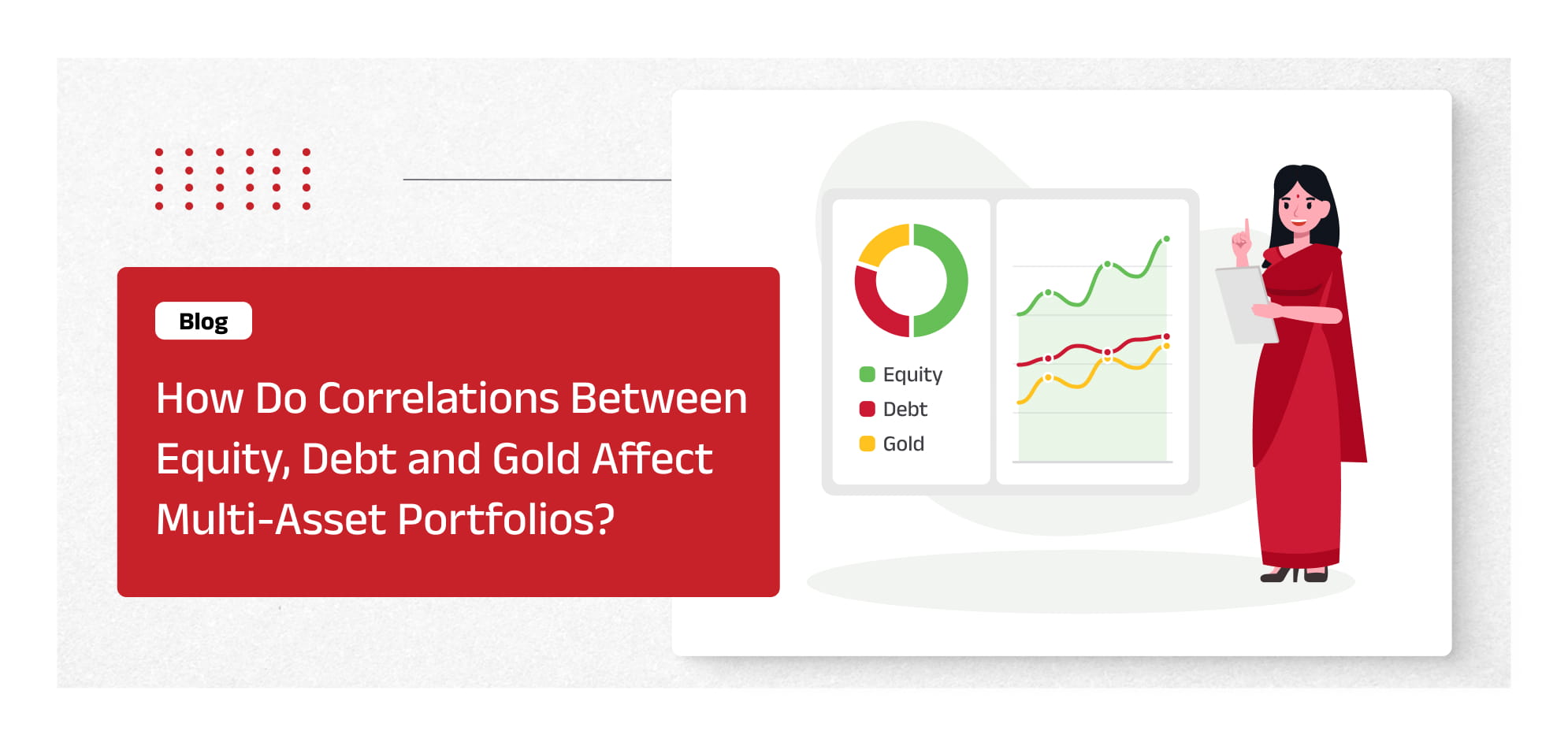
How Do Correlations Between Equity, Debt and Gold Affect Multi-Asset Portfolios?
Nov 16, 2026
5 min
0 Rating
In September 2026, multi-asset allocation funds attracted ₹3,666.98 crore in net inflows, indicating continued investor interest in portfolios combining different asset classes.
(Moneycontrol)
However, combining investments does not automatically reduce risk. The effectiveness of multi-asset allocation depends partly on correlation, or how equity, debt and gold prices move relative to one another.
Key Takeaways
Correlation shows whether different asset classes tend to move together or independently.
Combining assets with low or negative correlation may help reduce overall portfolio volatility.
Equity, debt and gold behave differently across market cycles, but their correlations can change.
Investors should assess asset allocation, historical correlations and risk tolerance before investing.
What Is Correlation in Investing?
Correlation measures the relationship between the returns of two investments. It ranges from -1 to +1.
+1: Both assets move perfectly together in proportional terms.
0: No linear relationship exists between their returns.
-1: Both assets move in exactly opposite directions in proportional terms.
For example, if equity declines while gold gains, their returns may show negative correlation over the measured period.
Lower correlation can improve diversification, although the relationship may change during market volatility.
How Do Equity, Debt and Gold Typically Behave?
Each asset class responds to different economic and market factors.
| Asset Class | Main Influencing Factors | Typical Risk Characteristics |
|---|---|---|
| Equity | Corporate earnings, economic growth, market sentiment | Higher price volatility |
| Debt | Interest rates, credit quality, bond maturity | Interest-rate and credit risks |
| Gold | Global demand, uncertainty, currency movements | Commodity price and currency volatility |
An equity fund primarily invests in stocks, while a
debt fund invests in fixed-income securities.
Gold may behave differently during periods of economic uncertainty.
However, equity and debt returns can sometimes move together, particularly when inflation or interest-rate changes affect both markets. (Economic Times)
How Does Correlation Affect Multi-Asset Portfolio Risk?
A portfolio's risk depends on individual asset volatility, allocation weights and correlations between holdings.
When assets have low correlations, losses in one investment may be partly offset by movements in another.
For instance, falling equity prices may have a smaller impact on a portfolio if its debt and gold allocations remain relatively stable.
A multi-asset allocation fund invests across multiple asset classes, potentially reducing dependence on a single market segment.
As per SEBI's 2026 categorisation framework. multi-asset allocation schemes have to invest in at least three asset classes, with a minimum allocation of 10% to each. (SEBI)
However, diversification cannot eliminate market losses.
How Can Investors Understand Correlation Through Market Scenarios?
Different market conditions may produce different relationships between asset classes.
The Portfolio Stress-Test Lab
Consider a hypothetical portfolio containing 50% equity, 30% debt, and 20% gold.
| Scenario | Equity Return | Debt Return | Gold Return | Portfolio Return |
|---|---|---|---|---|
| Equity market correction | -15% | +4% | +10% | -4.3% |
| Broad market rally | +18% | +5% | -3% | +9.9% |
| Inflation-related pressure | -8% | -4% | +12% | -2.8% |
All figures are illustrative assumptions, not historical returns or forecasts. Returns exclude expenses and taxes.
In the first scenario, positive debt and gold returns partly offset equity losses. However, the portfolio still declines.
These scenarios demonstrate how different asset movements can influence overall portfolio outcomes without guaranteeing protection.
How Can Investors Assess Correlation Before Building a Portfolio?
Investors can follow a few general steps:
Compare historical returns: Examine equity, debt and gold returns over matching periods.
Check correlation values: Identify whether asset pairs have generally moved together or independently.
Examine volatility : Assess how sharply individual asset values fluctuate.
Review allocations: Determine whether portfolio weights match financial goals and risk tolerance.
Test market scenarios: Consider how the portfolio could perform if multiple assets decline simultaneously.
Historical correlation is useful, but it cannot reliably predict future relationships.
Does Adding Gold Always Reduce Portfolio Risk?
No. Gold may provide diversification benefits because its returns do not always follow equity market movements.
However, gold prices can decline independently or alongside other assets.
Its effectiveness depends on allocation size, purchase price, currency movements and market conditions.
An excessive gold allocation may introduce additional commodity-price risk rather than improving overall diversification.
How Often Should Investors Review Their Multi-Asset Allocation?
Investors may review their portfolios annually or after significant changes in financial circumstances.
Reviews should consider whether market movements have shifted asset weights away from intended allocations.
Rebalancing may help restore the desired risk exposure, but it can involve transaction costs and potential tax implications.
Frequent changes based solely on recent asset performance may not support long-term investment objectives.
Building a Portfolio That Can Navigate Changing Markets
Effective diversification requires understanding how investments interact, not simply increasing the number of assets held.
Investors should select allocations that align with their investment horizon, liquidity needs and capacity to withstand fluctuations.
Expert Note
Correlation estimates can differ depending on whether daily, monthly or annual returns are used. Comparing multiple historical periods may reveal relationships that a single long-term average could conceal.
Blog Disclaimer
The information herein is meant only for general reading purposes, and the views being expressed only constitute opinions and therefore cannot be considered as guidelines, recommendations or a professional guide for the readers. The document has been prepared on the basis of publicly available information, internally developed data, and other sources believed to be reliable. Recipients of this information are advised to rely on their own analysis, interpretations & investigations. Readers are also advised to seek independent professional advice in order to arrive at an informed investment decision.
Links to scheme pages are provided for informational purposes only and should not be construed as a recommendation of any specific mutual fund scheme.
SEBI Registration No. MF/020/94/8
Mutual Fund investments are subject to market risks, read all scheme related documents carefully.

Correlation measures the relationship between two assets' returns using a coefficient ranging from -1 to +1.
Their correlations vary across market conditions. Gold may show low or negative correlation with equities, while equity-debt correlations can change with interest rates and inflation.
Correlations may strengthen, weaken or reverse as investors respond to economic uncertainty, liquidity requirements and changing market expectations.
It may improve diversification, but the outcome depends on gold allocation, price movements and prevailing market conditions.
Combining assets with lower correlations may reduce overall portfolio volatility because their returns do not always move together.
Investors can compare historical correlations, assess asset volatility and select allocations consistent with their financial objectives and risk tolerance.