 Home Loans
 Personal Loans
 SME Loans
 Business Loans - Udyog Plus
 Loan Against Securites
 Loan Against Property
 Mutual Fund
 Stock and Securities
 Wealth
 Portfolio Management Services
 Pension Funds
 Life Insurance
 Health Insurance
 Wellness Solutions
 Pay Bills
 Pay for anything
 Pay Anyone
 Pay on Call
 Credit Cards
 Prepaid Gift Card




 1800-270-7000
-
Our Products
-
Self Care
- Downloads
- Learnings
- About Us
-
More
-
Shareholders
-
Shareholders
-
-
SIP Calculators

-
Shareholders
 Take the e-pledge this Vigilance Awareness Week 2026 towards ‘Probity For Prosperity'

ABC Solution 
Loans
Insurance


 AppStore
 Playstore
Aditya Birla Sun Life AMC Limited


Aditya Birla Sun Life AMC Limited

How to Evaluate Whether Your Flexi Cap Fund Is Aligned with Its Investment Mandate

Oct 30, 2026
5 min
0 Rating
Flexi cap funds continue to attract substantial investor participation. As of August 31, 2026, the category had 46 schemes, about 2.48 crore folios and net assets of
approximately ₹6.11 lakh crore. (SEBI)
As the category grows in scale, investors may want to check whether their flexi-cap fund is managed in line with its stated mandate, rather than judging it only by recent returns.
Key Takeaways
Flexi-cap funds must maintain at least sixty-five per cent of their assets in equity and related instruments.
Fund managers may change allocations across mid, large, and small-cap stocks within the scheme's mandate.
Factsheets and portfolio disclosures can help investors assess whether actual holdings remain consistent with the stated investment approach.
What Is a Flexi Cap Fund and How Does Its Mandate Work?
A flexi cap mutual fund is an open-ended equity scheme that can invest across large-cap, mid-cap and small-cap stocks. SEBI describes it as a dynamic equity scheme, which means the fund manager has flexibility to change the market-cap mix within the scheme's stated strategy. (SEBI)
This flexibility does not mean there are no boundaries. The portfolio must remain consistent with the scheme's investment objective, asset-allocation limits and applicable regulations.
SEBI's Minimum Equity Exposure Requirement for Flexi Cap Funds
Under SEBI's February 2026 categorisation framework, a flexi cap fund has to invest at least sixty-five per cent of its assets in equity and related instruments. (SEBI)
Unlike some other equity categories, SEBI does not prescribe a fixed minimum allocation separately to mid, large and small-cap stocks for flexi cap funds. This allows the market-cap mix to change depending on the fund strategy and market conditions.
A Checklist to Evaluate Your Fund's Mandate Alignment
Investors can review mandate alignment by checking whether:
the investment objective remains unchanged
equity exposure meets the prescribed minimum
the market-cap mix is consistent with the scheme's stated strategy
sector or stock concentration has changed materially
current holdings fit within the stated asset-allocation range
portfolio changes appear consistent with disclosures in the scheme documents
For example, if a flexi cap fund increases its large-cap exposure during a volatile period, that alone does not mean the fund has moved away from its mandate.
How to Read Portfolio Disclosures and Factsheets
A fund factsheet and monthly portfolio disclosure can help investors understand how the portfolio is actually positioned.
SEBI requires mutual funds to disclose scheme portfolios, including ISIN-level information, on their websites and the AMFI website within the prescribed timeline after each month-end. (SEBI)
While reviewing these documents, look at:
mid, small and large-cap allocation
major sector exposures
top stock holdings
cash or debt allocation
benchmark
changes from previous reporting periods
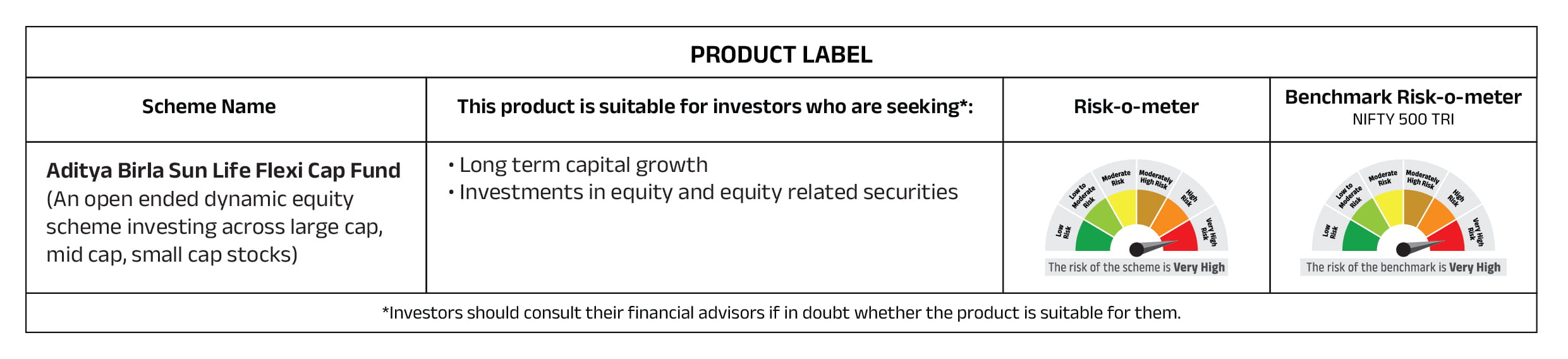
Investors reviewing the Aditya Birla Sun Life Flexi Cap Fund may consider its stated objective of seeking long-term capital growth through all range of investments.
Indicators That May Require Further Review
Not every portfolio change is a cause for concern. However, closer review may be warranted if:
the portfolio repeatedly appears inconsistent with the stated investment approach
equity exposure falls outside prescribed limits
concentration increases sharply
the investment style changes materially over time
portfolio positioning differs persistently from what the scheme documents describe
These indicators should lead to further evaluation rather than an immediate decision to exit.
What to Consider If Your Fund Appears Misaligned with Its Mandate
First, compare the latest portfolio with the Scheme Information Document and recent factsheets.
A temporary deviation may occur because of market movements or other circumstances. SEBI's framework provides for portfolio rebalancing where asset allocation moves outside prescribed limits. Depending on the type of deviation, specific rebalancing timelines and disclosure requirements may apply. (SEBI)
How to Evaluate Performance Alongside Mandate Alignment
Performance and mandate alignment should be reviewed together.
Compare the fund with its appropriate benchmark over more than one period and consider how much risk was taken to achieve those returns. A flexi cap fund with greater mid or small-cap exposure may experience sharper fluctuations than one with a larger large-cap allocation, depending on the market.
Short-term underperformance, therefore, does not automatically indicate poor mandate adherence.
Factors to Consider Before Making Changes to Your Flexi Cap Investment
Before switching or redeeming, consider:
whether your financial goal or investment horizon has changed
whether the fund's current strategy still suits your risk tolerance
whether the apparent deviation is temporary or persistent
overlap with other funds in your portfolio
applicable exit load
potential tax consequences
If you are reviewing the ABSL Flexi Cap Fund, look at whether its current mix across market-cap segments still reflects the flexibility described in the scheme mandate.
Blog Disclaimer
The information herein is meant only for general reading purposes and the views being expressed only constitute opinions and therefore cannot be considered as guidelines, recommendations or as a professional guide for the readers. The document has been prepared on the basis of publicly available information, internally developed data and other sources believed to be reliable. Recipients of this information are advised to rely on their own analysis, interpretations & investigations. Readers are also advised to seek independent professional advice in order to arrive at an informed investment decision.
Tax Disclaimer:
The Tax calculation shown above is for illustration purpose and general information only. Investors are advised to consult their Tax Consultant or Financial Advisor to determine tax benefits applicable to them.
SEBI Registration No. MF/020/94/8
Mutual Fund investments are subject to market risks, read all scheme related documents carefully.

A flexi-cap fund invests dynamically across mid, large, and small-cap stocks while following its stated investment objective and asset-allocation framework. (SEBI)
It must invest at least sixty-five per cent of its assets in equity and related instruments. (SEBI)
Compare its latest portfolio and factsheet with the investment objective and asset-allocation limits stated in its scheme documents.
The latest scheme factsheet and portfolio disclosure are useful starting points; mutual funds must periodically disclose portfolio information. (SEBI)
It may be worth reviewing if several funds hold many of the same stocks, as this could reduce the diversification expected from holding multiple schemes.
There is no common fixed schedule for all flexi cap funds; allocations may change according to the fund's strategy and market conditions.
Applicable SEBI rebalancing, reporting and disclosure requirements may apply depending on the nature and duration of the deviation. (SEBI)
Risk depends on the actual portfolio. Greater exposure to mid- and small-cap stocks may lead to higher volatility than a predominantly large-cap fund portfolio, depending on the market.
A switch may be treated as a transfer or redemption for tax purposes, and the tax impact depends on the holding period, gains realised and prevailing tax rules. (Income Tax Department)[S