 Home Loans
 Personal Loans
 SME Loans
 Business Loans - Udyog Plus
 Loan Against Securites
 Loan Against Property
 Mutual Fund
 Stock and Securities
 Wealth
 Portfolio Management Services
 Pension Funds
 Life Insurance
 Health Insurance
 Wellness Solutions
 Pay Bills
 Pay for anything
 Pay Anyone
 Pay on Call
 Credit Cards
 Prepaid Gift Card




 1800-270-7000
-
Our Products
-
Self Care
- Downloads
- Learnings
- About Us
-
More
-
Shareholders
-
Shareholders
-
-
SIP Calculators

-
Shareholders
 IMPORTANT ALERT ! Beware of Fake AMC App, Online Impersonation & Scam WhatsApp Groups.

ABC Solution 
Loans
Insurance



 AppStore
 Playstore
Aditya Birla Sun Life AMC Limited


Aditya Birla Sun Life AMC Limited

How Do Gold and Silver Exposure Impact a Multi-Asset Allocation Portfolio?
Oct 27, 2026
5 min
0 Rating
Gold and silver have seen sharp price movements in 2026, showing why commodities can behave very differently from equities and debt. In September 2026, gold futures fell about ₹4,300 per 10 grams over two sessions, while silver had declined around ₹8,800 per kg. (Economic Times)
For a multi-asset allocation fund, such movements matter because gold and silver may respond differently from equity and fixed-income assets. This can potentially support diversification, although commodity exposure does not guarantee lower risk or better returns.
Key Takeaways
Gold and silver may add diversification to equity and debt exposure.
Their impact on returns depends on market conditions and portfolio allocation.
Gold and silver can behave differently, so both may play distinct roles.
Commodity exposure can still be volatile and may underperform at times.
Investors should evaluate the overall asset mix, risk profile and investment horizon before investing.
What Is a Multi-Asset Allocation Fund?
A multi-asset allocation fund invests across at least three different asset classes. These may include equities, debt, gold, silver or other permitted assets.
The purpose of multi-asset allocation is to avoid depending entirely on a single asset class. When one part of the portfolio faces pressure, another may behave differently depending on the market.
For example, assume a portfolio has ₹10 lakh invested across equity, debt and commodities. If equities experience a weak period while gold prices rise, the gold exposure may partly offset the decline. However, this effect is not assured because different asset classes may sometimes fall together.
Understanding SEBI's Minimum 10% Allocation Mandate Across Asset Classes
SEBI classifies a multi-asset allocation fund as a scheme investing in a minimum of three asset classes. The minimum allocation should be 10% in each of those three asset classes. (SEBI)
Importantly, this does not mean every multi-asset fund must hold 10% gold and another 10% silver. The 10% requirement applies to each of the three asset classes selected under the scheme's mandate.
The remaining allocation may vary within the limits stated in the scheme documents.
Role of Gold and Silver in a Multi-Asset Allocation Fund Portfolio
Gold and silver can play different roles within a diversified portfolio.
Gold allocation in portfolio construction is often considered because gold may react differently to equity markets, currencies, interest rates and geopolitical uncertainty.
Silver allocation may provide commodity diversification too, but silver also has significant industrial demand. This can make its price movements more sensitive to both investment sentiment and economic activity.
This difference means gold and silver should not automatically be treated as identical assets. Depending on the market, one commodity may perform differently from the other.
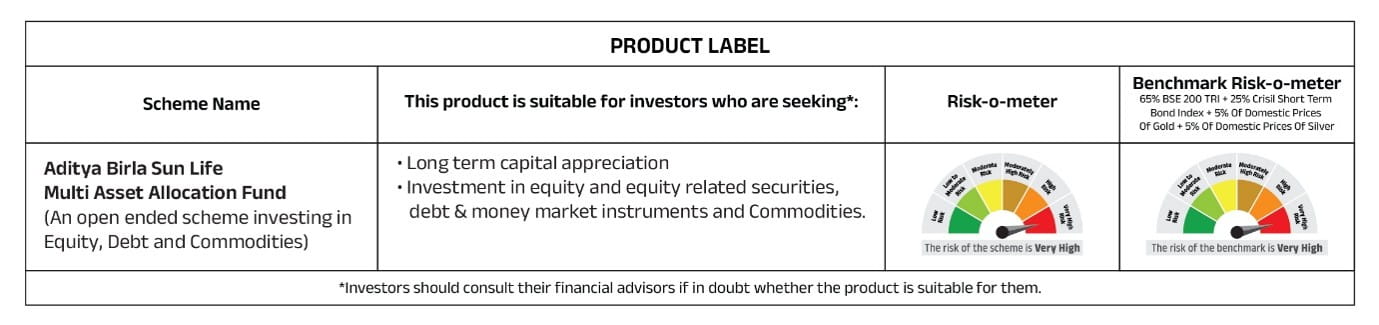
In the case of the Aditya Birla Sun Life Multi Asset Allocation Fund, the scheme's stated allocation range is 65%-80% in equity and equity-related instruments, 10%-25% in debt and money-market instruments, and 10%-25% in commodities. That includes gold and silver-related instruments. (Aditya Birla Mutual Funds)
How Gold and Silver Exposure Affects Portfolio Volatility and Returns
Adding gold and silver may change both the return pattern and volatility of a multi-asset portfolio.
The potential benefit comes from different return drivers. Equity prices depend heavily on corporate earnings and economic growth, while gold may be influenced by interest rates, currencies and demand for defensive assets. Silver also responds to industrial demand.
However, commodities can themselves be volatile. In September 2026, gold futures fell ₹3,214 per 10 grams in one session, while silver declined ₹6,661 per kg. (Economic Times)
Therefore, commodity allocation may diversify risk, but it does not eliminate volatility.
Who Should Consider a Multi-Asset Allocation Fund with Gold and Silver?
Such a fund may be relevant for investors who want exposure to multiple asset classes through one scheme instead of managing separate equity, debt and commodity investments.
It may suit investors with:
A medium- to long-term investment horizon
Willingness to accept market-linked fluctuations
A need for diversified asset exposure
Comfort with changes in portfolio allocation over time
The ABSL Multi Asset Allocation Fund may suit investors seeking diversified exposure across equity, debt, and commodities within a single portfolio, depending on their investment horizon and risk profile.
Key Risks and Limitations of Gold and Silver Exposure in Multi-Asset Funds
Gold and silver exposure comes with specific risks.
Commodity prices can fall because of changes in interest rates, currency movements, global demand or investor sentiment. Silver may also experience larger swings because of its industrial use.
A fund may invest in commodities through exchange-traded instruments rather than holding physical metals directly. This can introduce tracking differences and market-related risks.
There is also an opportunity cost. During periods when equities perform strongly, a meaningful commodity allocation may limit participation in equity gains.
Expert Note
Gold and silver may strengthen diversification when combined thoughtfully with equity and debt. Their role is most effective when aligned with the fund’s broader asset allocation strategy.
Blog Disclaimer
The information herein is meant only for general reading purposes and the views being expressed only constitute opinions and therefore cannot be considered as guidelines, recommendations or as a professional guide for the readers. The document has been prepared on the basis of publicly available information, internally developed data and other sources believed to be reliable. Recipients of this information are advised to rely on their own analysis, interpretations & investigations. Readers are also advised to seek independent professional advice in order to arrive at an informed investment decision.
SEBI Registration No. MF/020/94/8
Mutual Fund investments are subject to market risks, read all scheme related documents carefully.

It is an mutual fund investing in at least three asset classes with a minimum 10% allocation to each.
Gold and silver may add diversification because their price drivers can differ from equity and debt.
SEBI requires at least 10% investment in each of a minimum of three asset classes. (SEBI)
There is no universal percentage; the allocation depends on the scheme's stated investment mandate.
It may diversify portfolio risk, but it cannot guarantee lower volatility or prevent losses.
Tax treatment depends on the scheme's equity exposure and applicable tax classification at the time of redemption.
Yes, both commodities may underperform depending on interest rates, demand, currencies and other market conditions.
They may use permitted commodity-linked instruments such as gold and silver ETFs, depending on the scheme mandate.
A medium- to long-term horizon may be more appropriate, depending on the investor's goals and risk tolerance.
Its mandate allows 10%-25% in commodities, including gold and silver-related instruments, with actual allocation varying over time. (Aditya Birla Mutual Funds)
The fund is designed to provide exposure to India’s equity markets through the MSCI India Index. Investors with a long-term horizon and the ability to withstand market volatility may consider it, depending on their financial goals and risk profile.