 Home Loans
 Personal Loans
 SME Loans
 Business Loans - Udyog Plus
  Loan Against Securites
 Loan Against Property
 Mutual Fund
 Stock and Securities
 Wealth
 Portfolio Management Services
 Pension Funds
 Life Insurance
 Health Insurance
 Wellness Solutions
 Pay Bills
 Pay for anything
 Pay Anyone
 Pay on Call
 Credit Cards
 Prepaid Gift Card



 1800-270-7000
-
Our Products
-
Self Care
- Downloads
- Learnings
- About Us
-
More
-
Shareholders
-
Shareholders
-
-
SIP Calculators

-
Shareholders
 IMPORTANT ALERT ! Beware of Fake AMC App, Online Impersonation & Scam WhatsApp Groups.

ABC Solution 
Loans
Insurance



 AppStore
 Playstore
Aditya Birla Sun Life AMC Limited


Aditya Birla Sun Life AMC Limited

How to Choose the Right Flexi Cap Fund for Your Investment Goals?

Aug 19, 2026
5 min
0 Rating
Large, mid-sized and smaller listed companies can behave differently across market cycles. A flexi cap strategy allows the portfolio manager to decide how much exposure to maintain across these segments instead of following a predetermined allocation to each.
This makes the category flexible, but it also makes fund selection important. Two flexi cap schemes can have significantly different portfolios even though they belong to the same mutual fund category. Understanding these differences can help investors identify a fund that better aligns with their financial goals and investment horizons.
What Is a Flexi Cap Fund?
A flexi cap mutual fund is an equity-oriented scheme that can build its portfolio using companies across large-cap, mid-cap and small-cap segments.
SEBI requires flexi cap schemes to maintain at least 65% of their assets in equity and equity-related instruments. Beyond this requirement, the fund manager can determine the market-cap mix according to the scheme's investment strategy. (Source)
This approach provides access to businesses of different sizes, while the portfolio continues to carry the potential risks associated with equity investing.
How to Choose the Right Flexi Cap Fund
Knowing how to choose the right mutual fund involves evaluating several factors together.
1. Match the Fund with Your Financial Goal
Start by identifying the purpose of the investment and the period for which the funds can remain invested. A longer horizon can provide more time to navigate equity-market fluctuations.
2. Understand Your Risk Profile
Flexi cap funds can hold mid- and small-cap companies alongside larger businesses. Since these segments can experience different levels of volatility, review the scheme's Riskometer before investing.
3. Study the Investment Approach
Look at how the fund identifies companies and constructs their portfolio. Understanding whether the strategy is driven by valuations, growth prospects, business quality or a combination of factors provides better context than category classification alone.
4. Examine the Market-Cap Mix
Check how the portfolio is distributed among large-, mid- and small-cap companies. Reviewing this allocation over time can also show how actively the manager changes positioning when market opportunities evolve.
5. Assess the Fund Management Process
Fund-manager experience is useful, but it should not be considered independently. Review the manager's tenure along with the consistency of the investment process and portfolio strategy.
6. Compare Performance Across Market Phases
Avoid judging a fund solely by its latest one-year performance. Examine longer periods and compare the scheme with its benchmark and relevant category peers to understand historical consistency.
Past performance does not indicate future investment outcomes.
7. Understand the Cost of Investing
The expense ratio represents an ongoing cost charged to the scheme. Compare it with similar funds but avoid treating a lower expense ratio as the only selection criterion.
8. Review Potential Risk Indicators
Metrics such as standard deviation and beta can provide additional information about historical volatility and market sensitivity. These measures are more useful when considered alongside the portfolio and investment strategy.
Key Features of a Flexi Cap Mutual Fund
Exposure Across Market-Cap Segments: The portfolio can include established large-cap businesses as well as selected mid-cap and small-cap companies.
Flexible Portfolio Allocation: The manager can alter the relative exposure to different company sizes based on the scheme's strategy and investment opportunities.
Diversification Within Equities: Investments can be distributed across companies, sectors and market-cap segments rather than being concentrated in one part of the equity market.
Active Investment Management: Portfolio holdings and allocation decisions are based on the fund management team's research and investment framework.
Equity-oriented Approach: Significant exposure to equities creates potential for long-term capital appreciation, along with the potential risks associated with market movements.
Potential Benefits of Investing in a Flexi Cap Fund
Access to Different Company Sizes: Investors can participate in large-, mid- and small-cap opportunities through one equity fund.
Ability to Adjust Portfolio Positioning: The fund manager can change the market-cap mix when valuations, business fundamentals or investment opportunities evolve.
Broader Equity Exposure: Investments across different market segments can reduce dependence on one company-size category, although diversification cannot eliminate potential risks.
Professional Portfolio Management: Company selection, portfolio monitoring and allocation decisions are managed within the scheme's stated investment framework.
Participation in Varied Growth Opportunities: The portfolio can combine established businesses with selected companies that may offer future growth potential.
Who May Consider a Flexi Cap Fund?
A flexi cap fund may be considered by investors seeking equity exposure across different market-cap segments through one portfolio.
It may be more relevant for those who have an investment horizon suitable for equities, can tolerate fluctuations in portfolio value and prefer professional management of market-cap allocation.
A Quick Checklist Before Investing
Before selecting a flexi cap fund, check:
financial goal and investment horizon;
Riskometer and potential risk profile;
market-cap and sector exposure;
investment strategy;
fund-manager tenure and process;
historical consistency across periods;
expense ratio;
comparison with the appropriate benchmark
overlap with existing equity holdings.
When researching options, investors may also come across searches for Aditya Birla Flexi Cap Fund or Aditya Birla Flexicap Fund. The official scheme is Aditya Birla Sun Life Flexi Cap Fund. Its latest portfolio, Riskometer, investment objective and scheme documents should be reviewed before evaluating whether it fits an existing portfolio.
Blog Disclaimer
The information herein is meant only for general reading purposes, and the views being expressed only constitute opinions and therefore cannot be considered as guidelines, recommendations or a professional guide for the readers. The document has been prepared on the basis of publicly available information, internally developed data, and other sources believed to be reliable. Recipients of this information are advised to rely on their own analysis, interpretations & investigations. Readers are also advised to seek independent professional advice in order to arrive at an informed investment decision.
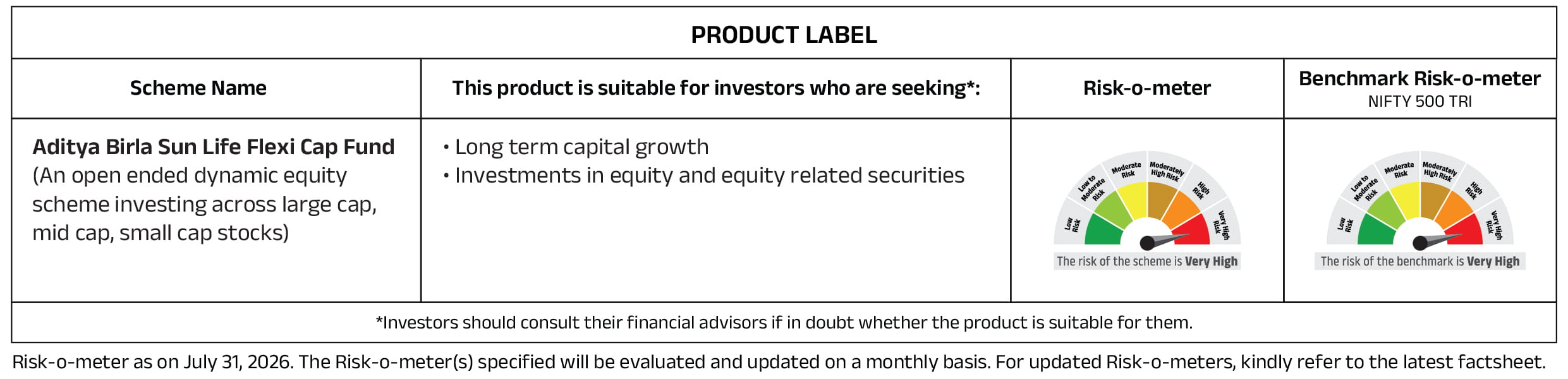
Mutual Fund investments are subject to market risks, read all scheme related documents carefully.

A flexi cap fund is an equity-oriented fund that can invest across large-cap, mid-cap and small-cap companies.
The fund manager selects companies across market-cap segments and can adjust their relative weights according to the scheme's investment strategy.
Consider financial goals, investment horizons, potential risks, investment strategy, costs and historical consistency before selecting a scheme.
Review its market-cap allocation, Riskometer, investment process, expense ratio, fund management and existing portfolio overlap.
It may be considered by investors seeking diversified equity exposure and who are comfortable with market fluctuations over an appropriate horizon.
Flexi cap funds can alter allocations across market caps, while multi cap funds follow prescribed minimum exposure requirements across the three market-cap segments.
Potential risks can arise from equity-market movements and exposure to companies across different market-cap segments.
Yes, flexi cap funds generally offer SIP facilities, subject to the terms and minimum investment requirements of the individual scheme.
The scheme can be evaluated for long-term goals, but suitability depends on an investor's financial objectives, investment horizon and potential risk profile.