 Home Loans
 Personal Loans
 SME Loans
 Business Loans - Udyog Plus
 Loan Against Securites
 Loan Against Property
 Mutual Fund
 Stock and Securities
 Wealth
 Portfolio Management Services
 Pension Funds
 Life Insurance
 Health Insurance
 Wellness Solutions
 Pay Bills
 Pay for anything
 Pay Anyone
 Pay on Call
 Credit Cards
 Prepaid Gift Card




 1800-270-7000
-
Our Products
-
Self Care
- Downloads
- Learnings
- About Us
-
More
-
Shareholders
-
Shareholders
-
-
SIP Calculators

-
Shareholders
 IMPORTANT ALERT ! Beware of Fake AMC App, Online Impersonation & Scam WhatsApp Groups.

ABC Solution 
Loans
Insurance



 AppStore
 Playstore
Aditya Birla Sun Life AMC Limited


Aditya Birla Sun Life AMC Limited

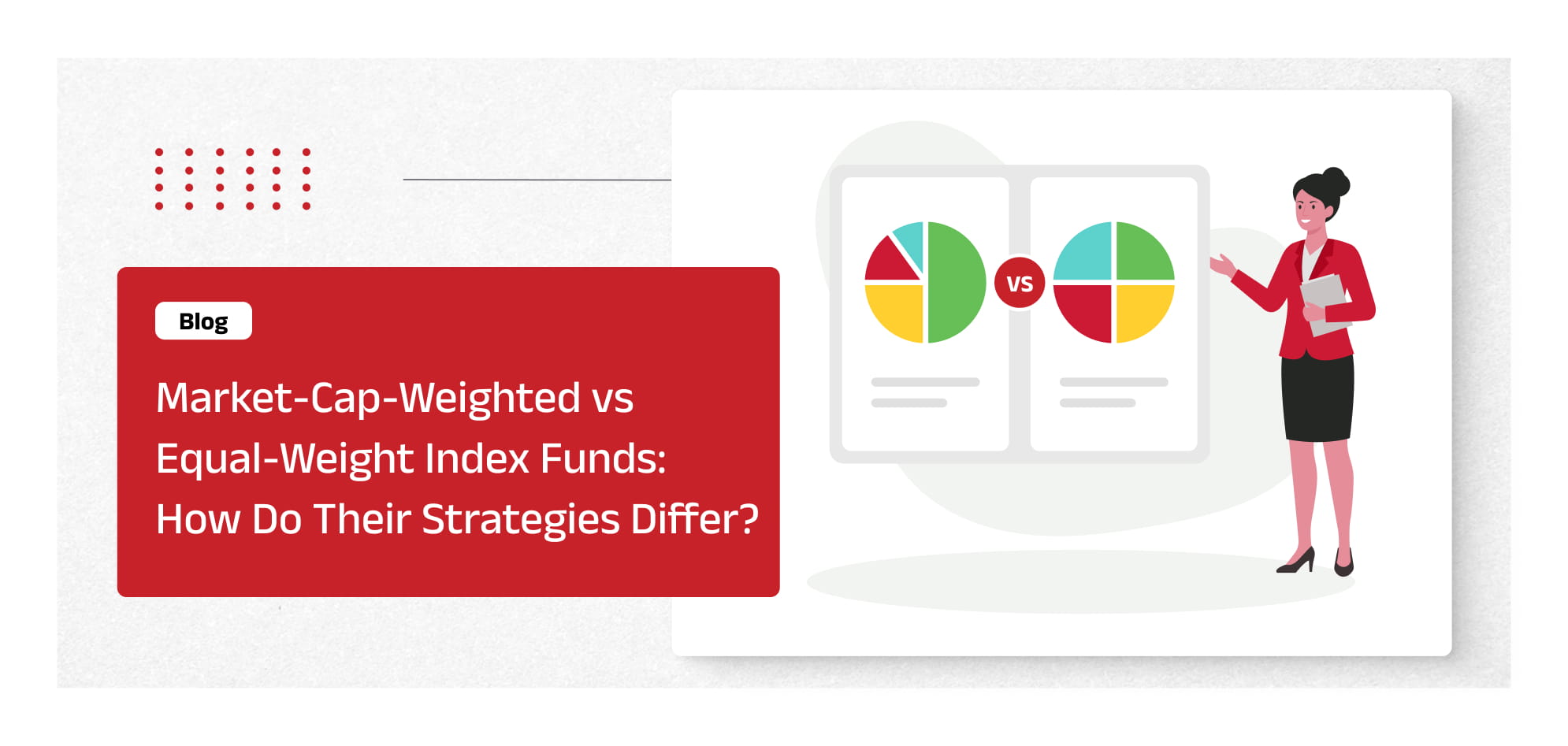
Market-Cap-Weighted vs Equal-Weight Index Funds: How Do Their Strategies Differ?
Nov 16, 2026
5 min
0 Rating
In September 2026, the top 10 holdings of a Nifty 50 equal-weight index fund accounted for approximately 20.58% of its portfolio, with the largest holding representing just 2.11%. (The Economic Times)
This distribution illustrates how an equal-weight index fund limits dependence on individual companies. However, a market cap-weighted index follows a different approach, giving larger companies more influence.
Understanding these strategies can help investors choose suitable passive investments.
Key Takeaways
Market-cap weighting gives larger companies greater influence over index performance.
Equal weighting reduces individual-stock concentration at rebalancing but may increase exposure to relatively smaller companies.
Market leadership, volatility and rebalancing costs influence relative performance.
Investors should compare overall portfolio exposure rather than relying solely on historical returns.
What Is a Market-Cap-Weighted Index Fund?
It is a fund that tracks an index where companies receive weights based on their market capitalisation, often adjusted for publicly available shares.
Larger companies receive higher allocations, while smaller companies receive lower allocations.
For example, a company with a 12% index weight has a greater impact on index returns than one with a 2% weight.
The Nifty 50 follows a free-float market-capitalisation-weighted methodology, meaning its constituent weights depend on eligible
shares available for public trading. (SEBI Investor Education)
This approach allows weights to change naturally with share prices, although it can create concentration in larger companies.
What Is an Equal-Weight Index Fund?
It is a fund that tracks a benchmark that assigns the same weight to each constituent during scheduled rebalancing.
For example, an index containing 50 companies would allocate approximately 2% to each company at rebalancing.
Weights subsequently change with market movements until the next adjustment.
Equal-weight indices generally require periodic rebalancing to restore equal allocations. This may lead to additional trading costs.
Unlike market-cap weighting, company size does not determine the initial allocation to each constituent.
Market-Cap-Weighted vs Equal-Weight Index Funds: A Comparison
| Factor | Market-Cap-Weighted | Equal-Weight |
|---|---|---|
| Allocation | Based on company size | Equal allocation to constituents |
| Large-company influence | Generally higher | Limited at rebalancing |
| Concentration | May be concentrated in a few stocks | More evenly distributed across stocks |
| Rebalancing | Primarily for index reviews and corporate actions | Also restores equal weights periodically |
| Portfolio turnover | Generally lower | Potentially higher |
| Performance drivers | Larger companies have greater influence | Each constituent starts with equal influence |
Both approaches can be followed through a passive index fund, but neither consistently outperforms the other. (Index Mutual Funds, SEBI)
How Do the Two Strategies Behave in Different Market Conditions?
Performance differences depend on which companies lead or decline during a market cycle.
Large-company-led rallies: Market-cap-weighted indices may perform better when their biggest constituents generate strong returns.
Broad-based rallies: Equal-weight indices may benefit when gains extend across numerous companies.
Market corrections: Equal-weight funds may experience greater losses if smaller constituents decline more sharply.
Concentrated declines: Market-cap-weighted funds may face greater pressure when heavily weighted companies underperform.
Equal weighting does not automatically reduce overall volatility. Factors such as company exposure, sector composition and market conditions remain important.
Understanding How Weighting Changes Your Exposure with a ₹1 Lakh Investment Example
Consider an illustrative ₹1 lakh investment tracking an index containing five companies.
| Company | Market-Cap Weight | Amount Invested | Equal Weight | Amount Invested |
|---|---|---|---|---|
| A | 40% | ₹40,000 | 20% | ₹20,000 |
| B | 25% | ₹25,000 | 20% | ₹20,000 |
| C | 15% | ₹15,000 | 20% | ₹20,000 |
| D | 12% | ₹12,000 | 20% | ₹20,000 |
| E | 8% | ₹8,000 | 20% | ₹20,000 |
Illustrative allocations only; these are not actual fund holdings or return projections.
In the market-cap-weighted portfolio, the largest company accounts for 40% of the investment. Under equal weighting, each company receives 20%.
The Hidden Concentration Test
Investors can use three questions to assess portfolio concentration:
Top five exposure: What percentage of the portfolio belongs to its five largest holdings?
Sector concentration: Are multiple companies exposed to the same industry?
Size exposure: Does the weighting method increase exposure to relatively smaller companies?
Equal weights do not guarantee equal sector diversification. For instance, the Nifty 500 Equal Weight Index had approximately 50% small-cap exposure, compared with around 10% in its market-cap-weighted parent index, as reported in September 2026. (Live Mint)
Which Index Fund Strategy May Suit Your Investment Approach?
A market-cap-weighted strategy may suit investors seeking exposure that broadly follows the market's largest constituents.
An equal-weight approach may appeal to investors seeking less dependence on individual large companies and willing to accept periodic rebalancing.
Before selecting an index fund, consider its expense ratio, tracking difference, investment horizon, concentration and risk profile. Neither weighting approach eliminates equity market risk.
Choosing a Strategy That Complements Your Portfolio
The weighting method determines how market movements affect an investment. Before selecting a strategy, examine whether its company and sector exposure complements your existing holdings.
A suitable approach should support your financial objectives without requiring frequent changes based on short-term performance.
Expert Note
Compare both strategies over identical periods using total return indices rather than price returns alone. Also examine tracking difference, since actual fund returns may vary from benchmark performance after expenses.
Blog Disclaimer
The information herein is meant only for general reading purposes, and the views being expressed only constitute opinions and therefore cannot be considered as guidelines, recommendations or a professional guide for the readers. The document has been prepared on the basis of publicly available information, internally developed data, and other sources believed to be reliable. Recipients of this information are advised to rely on their own analysis, interpretations & investigations. Readers are also advised to seek independent professional advice in order to arrive at an informed investment decision.
Links to scheme pages are provided for informational purposes only and should not be construed as a recommendation of any specific mutual fund scheme.
SEBI Registration No. MF/020/94/8
Mutual Fund investments are subject to market risks, read all scheme related documents carefully.

Market-cap-weighted funds allocate more to larger companies, while equal-weight funds distribute investments equally among constituents at rebalancing.
It tracks an index that assigns equal weights to constituents and periodically rebalances holdings to restore those allocations.
Neither is universally better. Suitability depends on investment goals, risk tolerance, portfolio concentration and market conditions.
Market-cap-weighted funds may have greater exposure to dominant companies. Equal-weight funds distribute stock-level exposure more evenly but can retain sector concentration.
Their performance depends on which companies experience larger price movements. Equal weighting does not necessarily reduce losses during corrections.
Investors should assess company concentration, sector exposure, expenses, tracking difference, investment horizon and their capacity to withstand market fluctuations.