 Home Loans
 Personal Loans
 SME Loans
 Business Loans - Udyog Plus
  Loan Against Securites
 Loan Against Property
 Mutual Fund
 Stock and Securities
 Wealth
 Portfolio Management Services
 Pension Funds
 Life Insurance
 Health Insurance
 Wellness Solutions
 Pay Bills
 Pay for anything
 Pay Anyone
 Pay on Call
 Credit Cards
 Prepaid Gift Card



 1800-270-7000
-
Our Products
-
Self Care
- Downloads
- Learnings
- About Us
-
More
-
Shareholders
-
Shareholders
-
-
SIP Calculators

-
Shareholders
 IMPORTANT ALERT ! Beware of Fake AMC App, Online Impersonation & Scam WhatsApp Groups.

ABC Solution 
Loans
Insurance


 AppStore
 Playstore
Aditya Birla Sun Life AMC Limited


Aditya Birla Sun Life AMC Limited

Understanding SIF Hybrid Long Short Fund

Apr 01, 2026
5 min
0 Rating
SIF Hybrid Long-Short Funds offer HNIs a flexible, risk-managed strategy to pursue consistent returns and portfolio diversification across market conditions.
India’s mutual fund industry has grown rapidly in recent years. The total assets under management (AUM) in the industry surpassed ₹82 lakh crore in 2026, reflecting strong investor participation even amid market volatility.
Within this expanding landscape, hybrid strategies have become increasingly popular among investors seeking diversified exposure. Hybrid mutual funds attracted ₹1.19 lakh crore in inflows during FY25, highlighting the continued demand for strategies that combine multiple asset classes to balance risk and return.
What is SIF Hybrid Long-Short Funds?
SIF Hybrid Long-Short Funds are interval investment strategies under SEBI’s Specialised Investment Funds (SIF) framework that invest in equities, debt, and derivatives, combining long positions with limited short positions to manage risk and enhance returns.
These funds aim for capital appreciation and income while controlling volatility, offering HNIs a flexible strategy that is not solely dependent on market direction.
Recent industry data show that hybrid long-short fund strategies dominate the SIF category, accounting for 84% of total SIF AUM at ₹5,485 crore out of the ₹6,564 crore total as of January 2026.
For HNIs, these strategies may offer flexibility, as the portfolio manager can adjust positions across assets based on market conditions. However, the performance of long-short funds can vary based on market trends, asset allocation decisions, and risk management strategies.
How Do Hybrid Long-Short Funds Work
Under the Specialised Investment Funds (SIF) framework, Hybrid Long Short Funds blend traditional asset investing with tactical exposure to both rising and falling markets.
These funds maintain a balanced mix of equity and debt, with regulatory norms requiring minimum allocations, typically at least 25 % each to equity and to debt, while allowing limited short exposure through derivatives of up to around 25 % of the strategy’s assets.
In practice, the fund manager takes long positions in securities believed to appreciate and uses short derivative positions to hedge or potentially profit when markets or specific securities decline.
By combining these elements within controlled exposure limits, the strategy aims for risk managed returns across market conditions rather than relying solely on upward market trends.
What are the benefits of Hybrid Long-Short Funds for Investors?
Hybrid Long-Short strategies offer several advantages:
Reduced Volatility: Short positions and hedging help limit downside risk compared to traditional equity funds.
Diversification: These funds provide exposure to equity markets while managing market swings, complementing other asset classes in a portfolio.
Potential for Consistent Returns: By profiting from both upward and downward movements in select stocks, they aim for smoother performance over time.
Flexible Strategy: Fund managers can adjust the long-short balance depending on market conditions, enhancing the fund’s adaptability
Who Should Invest in Hybrid Long-Short Funds?
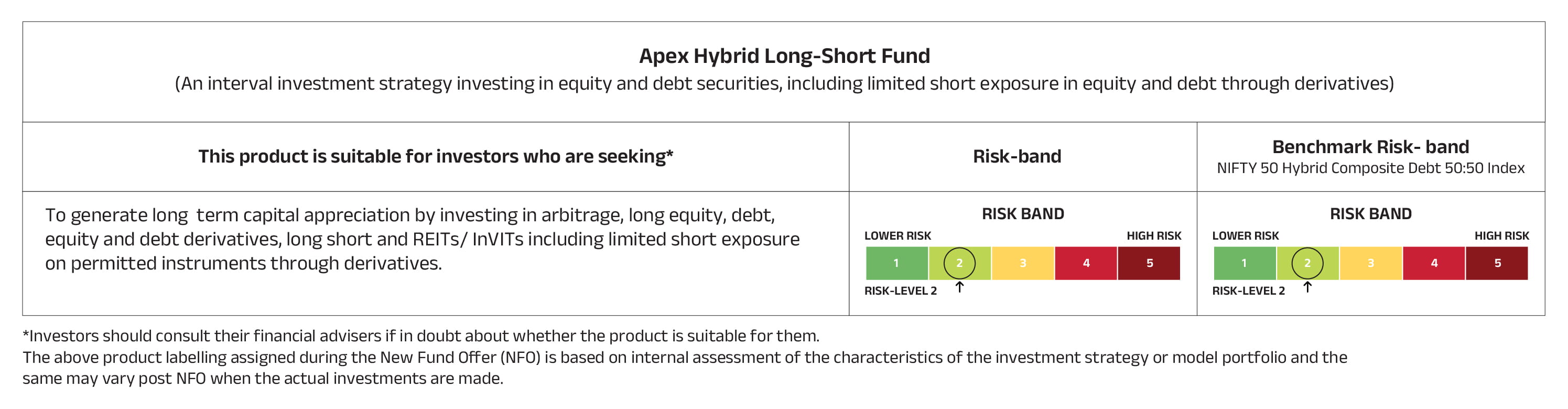
APEX Hybrid Long-Short Funds is suited for HNIs and sophisticated investors who:
Seek moderate to high risk-adjusted returns without fully exposing themselves to equity market volatility.
Want portfolio diversification and protection against market downturns.
Have a medium- to long-term investment horizon and are comfortable with complex strategies.
Prefer active fund management, relying on expert managers to navigate market trends.
These funds may not be ideal for conservative investors or those seeking purely passive income. They work best as part of a diversified portfolio aimed at growth with controlled risk.
Disclaimers:
The information herein is meant only for general reading purposes, and the views being expressed only constitute opinions and therefore cannot be considered as guidelines, recommendations or a professional guide for the readers. The document has been prepared on the basis of publicly available information, internally developed data, and other sources believed to be reliable. Recipients of this information are advised to rely on their own analysis, interpretations & investigations. Readers are also advised to seek independent professional advice in order to arrive at an informed investment decision.
Investments in Specialized Investment Fund involves relatively higher risk
including potential loss of capital, liquidity risk and market volatility. Please read all
investment strategy related documents carefully before making the investment
decision.
Source:
https://timesofindia.indiatimes.com/business/mutual-funds/mutual-fund-industry-aum-hits-record-rs-82-lakh-crore-in-february-sip-flows-stay-strong/articleshow/129638398.cms
https://economictimes.indiatimes.com/mf/mf-news/hybrid-mutual-fund-schemes-inflow-moderates-in-fy25-number-of-investors-aum-soar/articleshow/120662733.cms?from=mdr#:~:text=iStock-,Hybrid%20mutual%20fund%20schemes%20attracted%20Rs%201.19%20lakh%20crore%20
https://www.sebi.gov.in/sebi_data/attachdocs/sep-2025/1757501804475.pdf
https://www.businesstoday.in/personal-finance/investment/story/hybrid-sifs-take-the-lead-capturing-over-80-of-assets-in-indias-emerging-sif-market-report-515839-2026-02-12#:~:text=As%20of%20January%2031%2C%202026%2C%20hybrid%20SIF%20strategies%20control%.
https://www.businesstoday.in/personal-finance/investment/story/hybrid-sifs-take-the-lead-capturing-over-80-of-assets-in-indias-emerging-sif-market-report-515839-2026-02-12#:~:text=As%20of%20January%2031%2C%202026%2C%20hybrid%20SIF%20strategies%20control%.
https://www.sebi.gov.in/sebi_data/attachdocs/sep-2025/1757501804475.pdf

Yes, these funds aim for absolute returns by taking short positions in overvalued or declining stocks. While they cannot eliminate all risk, the strategy allows fund managers to potentially profit even when markets are bearish.
They may be considered by investors comfortable with moderately active strategies, though suitability depends on individual risk tolerance and market conditions.
Taxation depends on the holding period and type of gains: short-term capital gains (for holdings under one year) are taxed at a higher rate, while long-term gains enjoy concessional rates. HNIs should consider tax implications when planning investments in these funds.
Risk levels can vary depending on asset allocation, market exposure, and the use of derivatives, as well as market conditions.
Allocation depends on investment objectives, risk tolerance, and portfolio diversification needs, and may involve combining both strategies within a broader investment plan.