 Home Loans
 Personal Loans
 SME Loans
 Business Loans - Udyog Plus
 Loan Against Securites
 Loan Against Property
 Mutual Fund
 Stock and Securities
 Wealth
 Portfolio Management Services
 Pension Funds
 Life Insurance
 Health Insurance
 Wellness Solutions
 Pay Bills
 Pay for anything
 Pay Anyone
 Pay on Call
 Credit Cards
 Prepaid Gift Card




 1800-270-7000
-
Our Products
-
Self Care
- Downloads
- Learnings
- About Us
-
More
-
Shareholders
-
Shareholders
-
-
SIP Calculators

-
Shareholders
 IMPORTANT ALERT ! Beware of Fake AMC App, Online Impersonation & Scam WhatsApp Groups.

ABC Solution 
Loans
Insurance


 AppStore
 Playstore
Aditya Birla Sun Life AMC Limited


Aditya Birla Sun Life AMC Limited

When Are Small-Cap Mutual Funds Not Suitable for You?

Oct 27, 2026
5 min
0 Rating
Small-cap funds often attract attention when investor interest is high.
In July 2026, small-cap mutual funds received net inflows of ₹7,768 crore, up 39% from ₹5,602 crore in June. (Money Control) But strong inflows do not mean a small-cap fund suits every investor. These funds can see sharper ups and downs, especially during volatile markets.
So, the real question is whether the investor has the right risk tolerance, time horizon and liquidity comfort for that kind of exposure.
Key Takeaways
Small-cap funds invest predominantly in smaller listed companies and can experience significant price fluctuations.
They may not suit investors with short-term goals or low tolerance for market volatility.
SEBI requires a small-cap fund to invest at least 65% of its assets in equity and equity-related instruments of small-cap companies.
A longer investment horizon may provide more time to manage periods of market volatility, but it does not guarantee positive returns.
Risk tolerance, liquidity requirements and existing equity exposure should be assessed before investing.
Understanding Small-Cap Mutual Funds
Under SEBI's classification framework, small-cap companies are those ranked 251st onwards by full market capitalisation. (SEBI)
A small-cap MF must invest at least 65% of its assets in equity and equity-related securities of such companies. (SEBI)
These businesses may have room to grow, but they can also face challenges such as limited access to capital, lower trading liquidity and greater sensitivity to economic or business changes.
Why May Small-Cap Mutual Funds Not Be Suitable for Every Investor?
Small-cap funds can experience larger ups and downs than broader or large-cap-oriented equity investments.
They may therefore be difficult for investors who:
Prefer relatively lower fluctuations in portfolio value.
Need their money within a short period.
Are uncomfortable seeing temporary losses.
Already have significant exposure to small-cap stocks.
Depend on invested money for near-term expenses.
The possibility of higher long-term growth does not mean returns will be consistently higher.
When Should You Avoid Investing in a Small Cap Fund?
A small-cap fund may not be appropriate when an investor has a near-term financial goal or may need to withdraw money during a market downturn.
It may also be unsuitable when the investor's overall portfolio already has high exposure to aggressive equity investments.
For example, someone saving for an expense due in the next one or two years may not want to depend heavily on a small-cap fund because market volatility could affect the value available when the money is needed.
Understanding the Risks of Small-Cap Mutual Funds
The major risks include:
-
Market risk: Prices can fall during broader market corrections.
-
Liquidity risk: Some small-cap shares may trade less actively, particularly during stressed markets.
-
Business risk: Smaller companies may have less diversified operations or financial resources.
-
Volatility risk: Price movements can be sharper over short periods.
-
Valuation risk: Strong investor demand may sometimes push valuations higher, which can increase downside risk if expectations change.
These risks can affect returns differently depending on the market.
Small-Cap Mutual Funds and Investment Horizon
Small-cap investing generally requires the ability to remain invested through market cycles.
A longer investment horizon can give an investor more time to deal with periods of volatility and business cycles. However, a longer holding period itself does not guarantee returns or prevent losses.
Investors with short-term goals may therefore need to consider whether the volatility associated with small-cap mutual funds matches the timing of their financial requirement.
How to Assess Whether a Small Cap MF Fits Your Portfolio?
Before adding a small-cap allocation, an investor can ask:
-
How much equity risk is already present in the portfolio?
-
Can the investment remain untouched during a market fall?
-
Would a sharp decline cause the investor to exit prematurely?
-
Is the investment linked to a long-term rather than immediate goal?
-
Does the allocation create too much exposure to one market-cap segment?
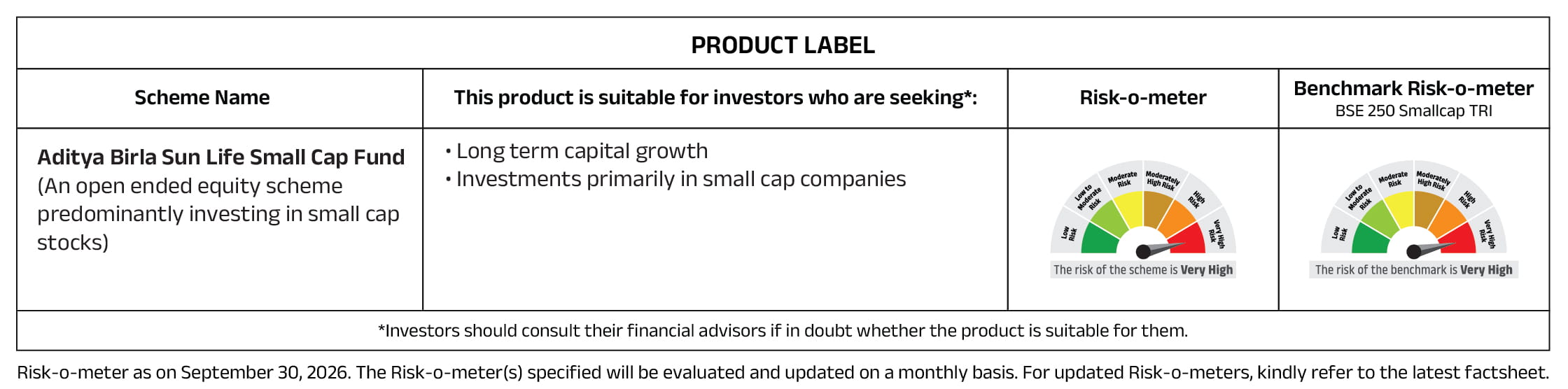
The Aditya Birla Sun Life Small Cap Fund can form part of a long-term equity portfolio for investors who are comfortable with the higher volatility associated with the small-cap category and want exposure to this segment as part of a diversified investment approach.
What Should You Consider Before Investing in a Small Cap Fund?
Three factors deserve particular attention.
-
Risk tolerance: Small-cap funds may experience significant fluctuations, so investors need to be comfortable with temporary declines.
-
Liquidity needs: Money required for emergencies or near-term expenses may not be suitable for exposure to a volatile equity category.
-
Portfolio allocation: Small-cap investing should be considered within the investor's overall asset allocation rather than as an isolated investment decision.
For example, suppose an investor needs money for a planned expense in two years. Even if a small-cap mutual fund has delivered strong returns recently, allocating a large portion of that money to the fund may expose the goal to short-term market fluctuations. For a longer-term goal, the investor may have more time to stay invested through market cycles, depending on risk tolerance and overall asset allocation.
Expert Note
Small-cap investing should be viewed as a risk-allocation decision, not simply a return-seeking decision. The key question is whether an investor can remain invested through periods of sharp volatility without disrupting financial goals or making emotional decisions.
Choosing Small-Cap Exposure with the Right Expectations
Small-cap funds can play a role in a long-term equity portfolio, but they need not be part of every investor's strategy.
The appropriate allocation depends on the investor's goals, risk capacity, investment horizon and existing portfolio.
Blog Disclaimer
The information herein is meant only for general reading purposes and the views being expressed only constitute opinions and therefore cannot be considered as guidelines, recommendations or as a professional guide for the readers. The document has been prepared on the basis of publicly available information, internally developed data and other sources believed to be reliable. Recipients of this information are advised to rely on their own analysis, interpretations & investigations. Readers are also advised to seek independent professional advice in order to arrive at an informed investment decision.
SEBI Registration No. MF/020/94/8
Mutual Fund investments are subject to market risks, read all scheme related documents carefully.

Investors with low risk tolerance, short-term goals or limited ability to handle portfolio fluctuations may find small-cap funds challenging.
They may be less suitable for short investment horizons because market volatility can affect the amount available when the money is required.
Higher risk tolerance may help an investor stay invested through sharp fluctuations, while a low tolerance for losses can make the category unsuitable.
Small-cap stocks can experience sharper price and liquidity changes during periods of market uncertainty, which can affect fund performance.
A longer horizon can provide more time to navigate market cycles, although it does not guarantee positive returns.
Investors who may need money at short notice could be forced to redeem during an unfavourable market period.
They may be considered by investors seeking long-term equity growth who can accept higher volatility and risk, depending on their overall portfolio and financial goals.